
AI Safety is the Primary Concern
All roads lead to AI safety, as this represents the critical discipline of preventing artificial intelligence from causing harm, whether those harms were caused by accidents, misuse, or systems behaving in unexpected and dangerous ways.
The discipline includes technical work on robustness and reliability as well as the practices that keep risk visible and manageable over time. Safety is the outcome that AI governance organizes, AI policy enforces, and AI alignment enables.
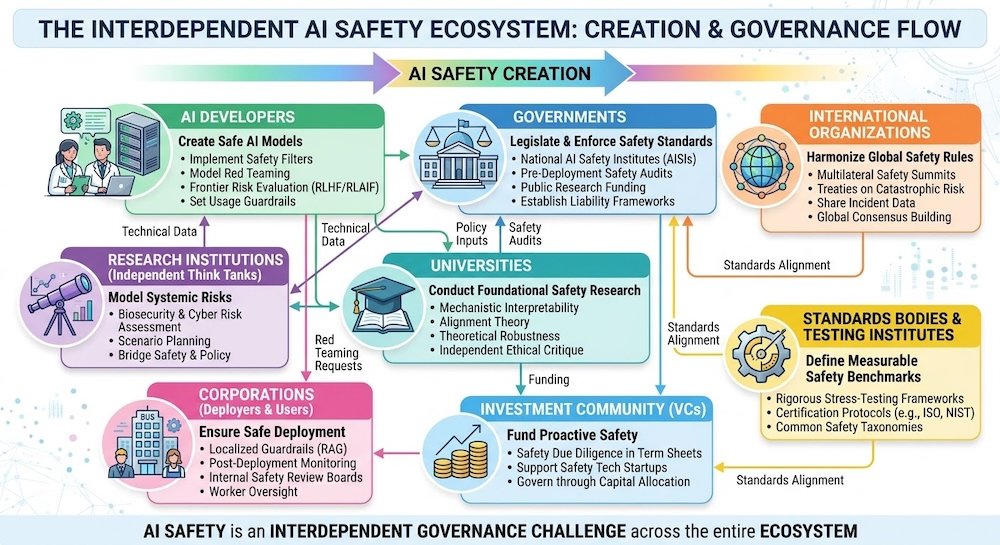
Image: Mark Lovett / AI GAPS — Generated with Gemini 3.8 Flash
1. AI Developers
- Actions: Implementing reinforcement learning from human feedback (RLHF), conducting pre-deployment red teaming exercises, setting up frontier risk tiers, such as Responsible Scaling Policies, and applying data filtering.
- Challenges: Scaling and Emergence. Safety techniques that work on smaller models often fail or behave unpredictably as models scale up, and developers face immense competitive pressure to bypass slow safety checks in order to accelerate the release cycle.
2. Governments
- Actions: Establishing National AI Safety Institutes, funding public-sector safety research, mandating pre-release safety evaluations for frontier models, and imposing export controls on compute.
- Challenges: Pace and Expertise. State agencies struggle to retain top technical talent against AI industry salaries, and statutory mandates often become outdated before they can be published and enforced.
3. Corporations
- Actions: Deploying runtime guardrails, such as prompt-injection filters, establishing human-in-the-loop workflows, and auditing vendor models for enterprise bias and drift.
- Challenges: The Black-Box Problem. Deployers must guarantee the safety of systems they did not build and cannot fully inspect, leaving them vulnerable to vendor flaws. They often lack the necessary expertise to fully audit their systems.
4. International Organizations
- Actions: Convening global safety summits, negotiating treaties on catastrophic risk mitigation, and sharing cross-border incident data regarding dangerous AI capabilities.
- Challenges: Geopolitical Rivalry. Major sovereign powers view AI safety research through a strategic competitive lens, making international verification and trust difficult to sustain.
5. Standards Bodies and Testing Institutes
- Actions: Developing standardized safety benchmarks, creating rigorous stress-testing frameworks, and defining common taxonomies for measuring model robustness and trustworthiness.
- Challenges: Subjectivity of what is “Safe.” Unlike traditional engineering, where safety metrics like load-bearing limits are physics-based, AI safety involves subjective social values, shifting definitions of harm, and rapid capability changes.
6. Universities
- Actions: Conducting foundational research on machine learning interpretability, mechanistic alignment, theoretical robustness, and long-term socio-technical risks.
- Challenges: The Compute Gap. Academic labs lack the massive compute infrastructure, or funds to pay for intensive computer, required to safely study frontier-scale models, shifting the frontier of safety research into private industry.
7. Research Institutions
- Actions: Mapping systemic risks, modeling worst-case scenarios, such as cyber offense or biosecurity risks, and translating complex safety concepts into actionable oversight strategies.
- Challenges: Access and Secrecy. Independent researchers often lack timely access to upcoming frontier models, forcing them to study safety retroactively rather than proactively.
8. Investment Community
- Actions: Implementing safety-focused due diligence, conditioning funding on adherence to safety frameworks, and supporting startups dedicated specifically to AI safety tools.
- Challenges: Misaligned Incentives. Investors traditionally prioritize high-growth over safe model engineering, often viewing prolonged safety audits as slowing their return on investment.
Insights
One of the major challenges to AI Safety is that the discipline looks very different depending on where you sit within the AI ecosystem. A frontier model developer must deal with alignment and frontier capabilities, whereas a university focuses its efforts on theoretical safety guarantees, and a standards body will spend its time on crafting measurement protocols.
When the various stakeholders operate with transparency, sharing information between disciplines and discussing methodologies, progress can be maximized. But when knowledge remains divided in silos, because of a desire to guard our intellectual property, solutions are limited in their effectiveness.