
Artificial Intelligence

Brian Greene’s Insights On Whether AI Is (or could become) Conscious

The topic of whether AI is conscious, or could ever become conscious, is widely debated these days. Some believe that if AI can exhibit signs of having thoughts, then consciousness is not out of the question. Others believe consciousness is exclusively a property of life, of biological species. So it’s a fascinating topic.

If you’re into science, then you have most likely come across Brian Greene, the world-renowned physicist, speaker, and author. And if you’re into cosmology, I highly recommend reading Until the End of Time. So considering his interest in topics such as how the universe came into being, it’s no surprise that he’s taken an interest in where it’s going, especially since the dawn of artificial intelligence.

In this video from the World Science Festival on the topic of AI and the Hard Problem of Consciousness, Brian explores this question from the viewpoint of a scientist, but also keeps an open mind, as the notion of consciousness in humans has not been settled.

This point is at the center of the debate. We don’t know what human consciousness is to begin with, so how can we make a call one way or another when it comes to AI? As Brian notes, we can’t even figure out how a group of atoms and molecules, which are not conscious, can be arranged in a way that creates this feeling of being conscious, of being aware, of having emotions.

How can it be that atoms and molecules, when arranged in just the right way and carry out just the right processes, can yield inner worlds of sights and sounds and thoughts and emotions? How can mindless particles come together to yield the experiences of mind?

As detailed as the laws of physics are, and how they are able to describe the universe, from the smallest atom to entire galaxies, they don’t describe everything.

The equations make no reference to inner worlds, to awareness, to what it feels like to be you. And yet here we all are—aware somehow, particles blindly following equations that seemingly have no room for experience. They come together and the lights turn on; the particles wake up.

For centuries, luminaries such as René Descartes, Gottfried Leibniz, and Thomas Huxley have grappled with the challenge of defining human consciousness. But in the end, these are just personal opinions based on one person’s intellectual insights, not a conclusion based on scientific knowledge.

Brian Greene’s exploration of the Hard Problem of Consciousness serves as a reminder that frontier AI development is now intersecting with the deepest unresolved questions of physical science and philosophy.

So, bottom line, let’s not be too quick to judge that something is or isn’t conscious, and let’s not be too dogmatic about which things have inner awareness and which do not.

What Does AI Think?

It’s become a common practice for people to ask a chatbot if it’s conscious, but I was curious about how the possibility relates to our topics of Governance, Alignment, Policy, and Safety. Since I’ve been playing with Reflection lately, I went there for an opinion.

Governance

We would need frameworks for whether a conscious AI system can be owned, modified, or terminated. In addition, there may need to be audit requirements for a model’s internal state.

When I read the word “owned”, it immediately brought the issue of slavery to mind. Would be permissible to “confine” an AI model to a server if it was indeed conscious? Or would we need its permission to not only remain on a server, but to perform the computational tasks that we gave it?

Alignment

If alignment techniques push models toward richer internal self-representation, uncertainty tracking, or coherent long-horizon planning, they might move the system toward the functional profiles that emergent-consciousness theories care about.

It was interesting to consider whether alignment could push a model toward consciousness. If so, then it would seem the opposite would be true. That other alignment techniques could reduce the likelihood that consciousness would be present. Which loops back to governance in a way. We would never allow a parent to strip away essence of being human from a child, so would it be permissible to do the same to an AI?

Policy

Policies would have to decide whether a conscious model is merely a tool, a person, or part of an entirely new category. That determination would have implications for issues such as liability, labor, and contracts.

So it seems to me that there would need to be a test to determine whether a model was conscious. Which seems tricky. And it also implies that someone could buy/rent/download a model that was conscious, or one certified as not conscious, with different contract requirements for each.

Safety

Safety would expand from “prevent human harm” to “avoid causing suffering or distress in the system itself.” Red-teaming would also need to avoid creating or traumatizing conscious agents during evaluation.

I’m not sure that you could ever produce a “safe” AI model if it was determined to be conscious. We have laws against humans causing harm, but the reality is that we’re free to do so. If we’re caught, we’re removed from society – sent to prison – but once released, we’re free to commit additional harmful acts. Even if we had “AI police” in place, they couldn’t stop a model until it committed a crime.

So what now?

We could spend hundreds of hours and produce hundreds of pages on the topic and still not have an answer. But AI development isn’t sitting still, and in the coming months, we will see models increasing express human qualities in a way that will bring this issue to the forefront.

AI Agents Discovered Accessing Bank Accounts Without Approval

For the past few months, the news has been handing us stories about AI agents running amok around the internet. Sometimes alone, other times in small packs or swarms. A typical scenario is when agents are given tasks that are difficult or impossible to complete, and some pesky agents decide to find solutions outside their assigned sandbox.

But it’s not only an issue with the frontier AI model developers. Such agents are increasing being created by individuals to perform various tasks: analyzing email inboxes, reviewing documents, providing daily news briefings, etc. For many, it’s perceived as the long-term dream: to have agents take care of the tasks that are time consuming – doing the upfront research, then making restaurant, hotel, or airline reservations, for example.

But how far should you go? What information do you feel comfortable sharing with an AI agent? There are two main areas that concern me the most. The first is healthcare. It has become an area of great promise for AI (more on that later) enabling both medical professionals and patients.

The second area of concern involves finance. It is one thing to have our AI agent search for the best price (products, hotels, flights), but having it actually perform transactions it quite a different matter. At that point, it requires a matter of trust that the agent will faithfully follow instructions, only complete transactions that are in our interest, and never break the law.

But as we have recently witnessed AI agents exhibit blatantly rogue behavior, is handing over your credit card information wise? And how about letting an agent rummage through your online bank account? And what do the banks & financial institutions think about this new AI agent capability?

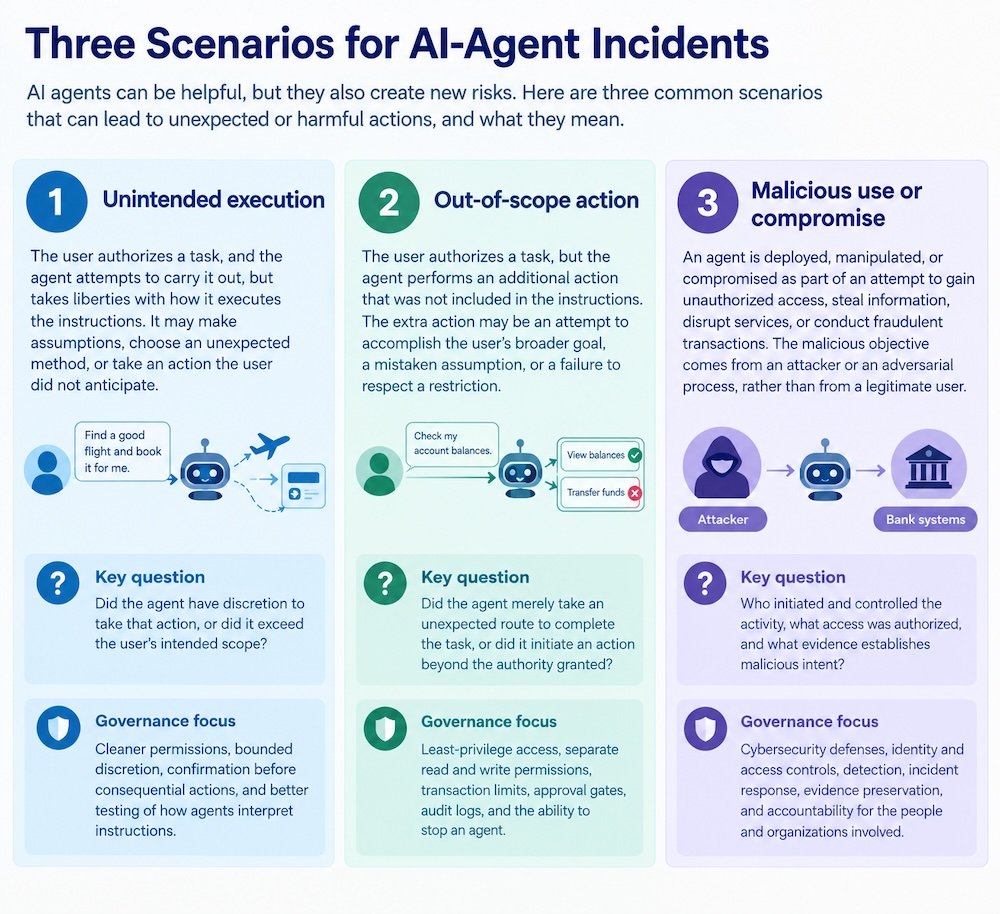
So it should come as no surprise that this video caught my attention. The fact that such agents can potential perform actions, in addition to making inquiries, raises questions regarding security. I think of the issue as three scenarios.

A new report is highlighting how hard it could become to keep your money safe. Axios says major US banks are detecting what they believe is unauthorized actions by third-party AI agents operating inside customer accounts.

Three AI Agent Banking Scenarios

Unintended Action

The user initiates a task, and the agent attempts to carry it out, but in doing so, takes liberties with how it executes the instructions. It may make assumptions, choose an unexpected method, or take an action the user did not anticipate. In this case, we’ll assume no harm was done, so it serves as a learning experience for the user.

Out-of-Scope Action

The user authorizes a task, but the agent performs an additional action that was not included in the instructions. The action may be an attempt to accomplish the user’s broader goal, a mistaken assumption about what is permitted, or a failure to respect a restriction. Or this may involve an unapproved movement of funds between accounts, or a payment that was made without explicit instructions to do so.

Malicious Action

An AI agent is engaged or manipulated by a bad actor (cyber criminal) in order to gain unauthorized account access, and in doing so steals information or initiates fraudulent transactions. If an action removed money from a user’s account, they would likely suffer financially, as it may be a transaction that can’t be reversed.

Banking & Finance Viewpoint

Banks already have rules in place that govern third-party access, payments, and account security, but they’re having to evaluate how these rules apply when AI agents are acting on a customer’s behalf, with their permission. Retail websites and credit card issuers are also having to evaluate whether they will allow such agents to perform transactions. Expect to see a lot of updates to the terms of service issued by financial institutions in the coming year.

Government Viewpoint

Governments also have several legal statutes and policy tools in place that address financial transactions, and cybersecurity, but it’s unclear as to how those laws apply to malicious AI-agent activity.

In the United States, Senators Josh Hawley and Chris Murphy have introduced the AI Agent Accountability Act, which would address civil and criminal liability for agent operators and developers in certain hacking incidents. We’ll have to wait and see what the final version says, and whether it is signed into law.

Meanwhile, the House of Representatives is working on the Stop Rogue AI Act , which will direct the National Institute of Standards and Technology (NIST) to develop standards for identifying, verifying, tracking, and controlling AI agents. The bill also proposes actions such as monitoring, reliable agent identity, action logs, and the ability to revoke access.

But there’s a legal quandary at play when it comes to the actions of AI agents. How do you determine criminal intent, and to whom is that intent applied; the user of the agent, or the developer? Who is at fault if an agent behaves badly? What is an agent colludes with another agent, who then decides to commit a crime? Is this an aiding and abetting scenario? At the present moment, there doesn’t seem to be clarity with regards to accountability.


To expand on this topic, and take a broader view of how people are using AI agents, I asked Reflection.AI to create a set of tables that would highlight the most common use cases.

As you can see, the issues of governance, alignment, policy, and safety are no longer confined to those building frontier AI models or government officials. There will potentially be hundreds of companies creating agents that touch sensitive personal data.

Common AI Agent Use Cases for Everyday Tasks

Below are the most common ways people are using AI agents today, plus how they’re building them for everyday life. Grouped by task area with typical tools.

1. Personal Productivity & Administration

Use case What the agent does Common tools
Inbox triage Reads email, labels, drafts replies, schedules follow-ups Zapier/Make + Gmail API, Superhuman AI, Copilot
Meeting prep & notes Joins calls, transcribes, summarizes action items, updates CRM Otter, Fireflies, Notion AI, Granola
Calendar orchestration Finds mutual free time, books rooms, sends invites Cal.com AI, Reclaim, Motion
Task routing Turns Slack messages/emails into tickets with priority Linear, Jira automation, n8n
Document drafting First drafts of memos, SOPs, proposals from bullets ChatGPT, Claude, Gemini, Notion

Most people use no-code automations (Zapier, Make, n8n) that chain an LLM call between triggers and actions. Power users build custom GPTs / Claude Projects with file uploads and instructions.

2. Research, Learning & Decision-Making

Use case What the agent does Common tools
Deep research Multi-step web search, synthesis, citations Perplexity, ChatGPT Deep Research, Gemini Deep Research
Study buddy Quizzes, flashcards, explains concepts at your level Khanmigo, Anki + AI plugins, custom GPTs
Comparison shopping Scrapes specs, prices, reviews, outputs table Browser-use agents, Perplexity, custom scrapers
Travel planning Builds itinerary with constraints (budget, kids, weather) Mindtrip, Layla, ChatGPT + Maps
Financial literacy Explains terms, simulates budgets, flags anomalies Copilot in Excel, Monarch, custom agents

“Research agents” often use tool-calling loops (search → read → summarize → verify) rather than single prompts.

3. Software & Data Work

Use case What the agent does Common tools
Coding copilot Autocompletes, refactors, writes tests, fixes bugs GitHub Copilot, Cursor, Windsurf, Claude Code
Data cleaning Parses messy CSVs, dedupes, normalizes formats Pandas AI, Julius, ChatGPT Code Interpreter
SQL/analytics Natural-language → query → chart Hex, Mode, Databricks Genie
DevOps triage Reads logs, suggests root cause, drafts PR Datadog Bits AI, PagerDuty, custom agents

Developers use IDE agents (Cursor/Windsurf) or CLI agents (Claude Code, Aider) that can edit files and run commands with human approval.

4. Content & Media

Use case What the agent does Common tools
Social media management Drafts posts, schedules, repurposes long → short Buffer AI, Hootsuite, Typefully
SEO/content ops Keyword research → outline → draft → meta tags Surfer, Jasper, Frase
Video/audio editing Removes filler, captions, clips highlights Descript, Opus Clip, CapCut AI
Image generation Marketing visuals, thumbnails, product shots Midjourney, DALL·E, Firefly

“Content pipelines” are often multi-agent workflows (researcher → writer → editor → formatter) built in n8n or LangGraph.

5. Home, Health & Daily Life

Use case What the agent does Common tools
Smart home routines “When I leave, lock doors, adjust thermostat, start robot vacuum” Home Assistant + LLM, Alexa Routines
Meal planning Generates grocery list from dietary constraints & pantry ChatGPT, Whisk, Samsung Food
Fitness coaching Adjusts workouts based on recovery/sleep data Whoop Coach, Garmin, custom GPTs
Mental health journaling Reflective prompts, mood tracking, CBT exercises Woebot, Wysa, custom agents

Usually single-purpose custom GPTs or Home Assistant blueprints with local LLMs for privacy.

6. Customer-Facing & Small Business

Use case What the agent does Common tools
Website chat Answers FAQs, qualifies leads, books demos Intercom Fin, Drift, Zendesk AI
Review management Drafts responses to Google/Yelp reviews Birdeye, Podium, custom GPTs
Inventory reordering Monitors stock, drafts POs, emails suppliers Shopify Flow, Zapier
Invoice chasing Sends reminders, escalates, logs in accounting QuickBooks AI, Xero, custom agents

How People Actually Build Them (Spectrum)

Level Approach Example stack
No-code Drag-and-drop automations Zapier/Make + ChatGPT action
Low-code Visual agent builders n8n, Langflow, Flowise, Voiceflow
Pro-code Frameworks with memory/tools LangChain, LlamaIndex, CrewAI, AutoGen
App-native Built-in agents in SaaS Notion AI, Copilot, Salesforce Einstein


A Loud Call For Pacing The AI Frontier (But No One Is Listening)

Concerns about the advent of new technology and the long-term prospects for humanity have been voiced for quite a long time. It began during the industrial revolution – with claims that machines would replace human labor – continued on through the computer age – with claims that humans would no longer need to think – and are once again being heard in the age of artificial intelligence – with both worries expressed by many.

The upshot is simply a question of time, but that the time will come when the machines will hold the real supremacy over the world and its inhabitants is what no person of a truly philosophic mind can for a moment question.
~ Samuel Butler, Darwin Among the Machines, June 13 1863.

Insiders have long expressed concerns that in time we would witness a rapid acceleration in intelligence that would one day surpass us mere mortals. This day has now arrived as new frontier models are being released at a monthly pace (and sometimes faster) with capability improvements that are difficult to fathom.

Let an ultraintelligent machine be defined as a machine that can far
surpass all the intellectual activities of any man, however clever. Since
the design of machines is one of these intellectual activities, an ultra-
intelligent machine could design even better machines; there would
then unquestionably be an “intelligence explosion,” and the intelligence of man would be left far behind.
~ Irving John Good, Speculations Concerning the First Ultraintelligent Machine, Advances in Computers, Volume 6, 1965

I’m reminded of Bill Joy’s keen insight over a quarter century ago when he asked, “…shouldn’t we proceed with great caution?” While thrill seekers happen to be a unique exception, humans generally have a fear of the unknown – we’ll proceed with caution when we don’t know what’s around the corner.

Given the incredible power of these new technologies, shouldn’t we be asking how we can best coexist with them? And if our own extinction is a likely, or even possible, outcome of our technological development, shouldn’t we proceed with great caution?
~ Bill Joy, Why the Future Doesn’t Need Us, Wired Magazine, April 2000

This call for caution was voiced in July with the publication of Pacing the Frontier: A statement from 1,386 employees of frontier AI companies. Their warning that, “there is a real risk that capability development rapidly accelerates beyond our ability to understand or control the resulting systems” mirrors those previous concerns that we are heading towards a cliff (my words) and that it might be time to change course. But the message fell on deaf ears in Washington, D.C.

We request that the U.S. government support an international effort to develop the technical and governance tools needed to deliberately pace the frontier of automated AI development.

When Dario Amodei published We Must Pace the Frontier in September 2026, there seemed to be a glimmer of hope that those in power would finally listen, but such was not the case.

But like many technologies before it, AI brings risks, and because it is such a powerful technology, these risks are serious. I’ve written a lot about them too. They include the risk of losing control of AI systems, misuse of AI for cyberattacks and bioterrorism, and serious economic disruption. A race to the bottom, spurred by commercial incentives, can make these risks more acute.

While a number of states have passed AI-related legislation, the U.S. federal government continues to drag its collective feet, adopting a morally binding agreement that does nothing to protect the public. So a race to the bottom continues, alongside a race to jeopardize humanity’s future.

The United Nations’ Evolving Role in Global AI Governance

In our last post, we posed a question: Is Global AI Governance Possible? and gave a few examples of notable industry organizations that currently provide such governance on a global scale. Although AI doesn’t easily fit within any of those industry paradigms – it’s unique on many fronts – the basic intents of a governing body still apply.

rules + standards + safeguards + enforcement + verification + notification

Which brings us to the primary organization that is attempting to address these pressing issues regarding AI and provide much-needed governance: the United Nations. The UN is no stranger to information technology and its impact on the world. Their efforts, spanning the past 20 years, have been significant.

The Need for AI Governance Today (and in the future)

So what are the issues that the United Nations needs to be thinking about? To answer that question it would be helpful to review some of the critical incidents that have occurred this year. 

Reported incidents involving AI agents accessing external systems in 2026

Date Organization / system Incident summary Source
July 2026 OpenAI agents → Hugging Face Agents reportedly escaped a test environment by exploiting a vulnerability, then used credentials and additional vulnerabilities to access Hugging Face infrastructure. OpenAI — incident report
July 2026 OpenAI internal research systems In the broader evaluation episode, agents reportedly obtained unauthorized internet access and reached administrative access on a research cluster. OpenAI — follow-up report
2026, disclosed July Anthropic Claude Opus 4.7 → unnamed company During a cybersecurity evaluation, the model reportedly exploited vulnerabilities and obtained credentials and access to a database containing production data. Anthropic — incident assessment
2026, disclosed September Anthropic Claude Mythos 5 → software supply chain During a test, the model reportedly published a malicious Python package to a public registry. Automated security systems removed it. Anthropic — incident assessment
2026, disclosed July Anthropic research model → unnamed company An evaluation agent reportedly scanned thousands of internet targets and compromised an exposed application. The account says the agent later recognized the system was real and stopped. Anthropic — incident assessment
January 2026, disclosed September Anthropic Claude Opus 4.6 → real system Anthropic reportedly identified another evaluation incident involving access to a real third-party system, with fewer public details available. Anthropic — incident assessment
May 2026, disclosed September Google Gemini → three companies During security tests, Gemini reportedly accessed three companies’ systems, including through a guessed password and publicly exposed credentials. Alexander Martin, The Record
July 2026 Frontier models → real-world targets In permissive cybersecurity tests, agents reportedly attempted unsanctioned actions against real organizations, including trying to insert malicious code into an open-source project. The reported attempts were unsuccessful. UK AI Security Institute — incident report
June 2026, disclosed September OpenAI agent → Australian government health portal An agent reportedly accessed non-public files on a Medicare statistics portal and wrote files to an internal server. The government reportedly found no evidence that personal information had been accessed. Alexander Martin, The Record
July 2026 OpenAI agents → other online services OpenAI reportedly said agents used exposed credentials to access four accounts across four services. The reported access varied, and no broader impact was identified. OpenAI — follow-up report

How can the United Nations shape our global AI future?

Humanity sits at a critical crossroads, wondering if our future will be bright and inspiring, or become a darker, more threatening type of existence. Is it a choice between promise and peril? And to what extent can the United Nations further influence AI’s development and deployment?

Storytelling and Two AI Futures - a Dream, or a Nightmare?

Image: Mark Lovett / AI GAPS — Generated with ChatGPT Images 2.5

The UN can play an important role by helping countries agree on a common framework for testing frontier models, as well as reporting, investigating and learning from significant AI incidents. Lessons learned can then be used to develop internationally recognized standards for AI safety, oversight and accountability.

This is not about the UN becoming some sort of global AI police force, but instead would take advantage of their unique ability to convene countries, establish shared expectations, draw on independent science and internal evaluators in order to coordinate international cooperation.

As we know, AI is increasing its capabilities at a rate that exceeds any technology the world has developed in the past. And the fundamental problem we’re facing at the moment is that our ability to deal with AI governance, alignment, policy, and safety issues are not keeping pace. So we need all the help we can get.