
The Four Pillars of AI
Artificial intelligence continues to influence our daily lives at an ever-increasing rate on a number of fronts: technology, financial services, manufacturing, and healthcare, to name just a few. And while AI’s capabilities continue to impress, we need to proceed with caution as the frontier providers, at the present time, are not able to produce AI models and agents which are truly safe & secure.
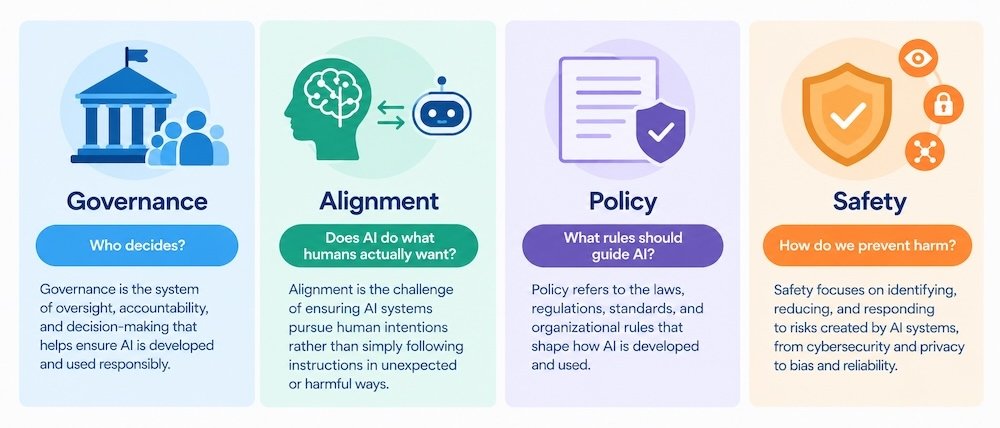
As such, it’s imperative that the public understand the key issues surrounding artificial intelligence in order to use it wisely, and pressure governments and corporations to prevent harm. AI GAPS is about inspiring conversations about four essential pillars: Governance, Alignment, Policy, and Safety. Each one is critical to ensuring AI works for everyone. These pillars also remind us of the gaps we need to close while developing and deploying AI.
AI Governance
Who decides how to build and deploy AI systems, and who is accountable when something does go wrong? AI Governance is the system of laws, oversight, and accountability that helps ensure all aspects of artificial intelligence are built and utilized responsibly. Stakeholders in this system include those building frontier AI, alongside governments, corporations, international organizations, and civil society.
Governance does not mean controlling every aspect of an AI system. Its goal is to answer questions such as: What rules & regulations are in place to oversee AI’s creation and use? How should we test and evaluate these systems? Who’s responsible whenever something goes wrong? How can countries cooperate, ensuring governance is adequate?
Further detail: AI Governance →
AI Alignment
The issue of AI alignment may be the most significant challenge that we have to deal with as it’s difficult to define, and difficult to implement. I feel it’s helpful to view the issue from the perspective of intent alignment vs. values alignment.
Intent Alignment: asks whether an AI system follows the instructions it’s given and/or achieves the goal of the person who is instructing the AI. In other words, “Did it do what I wanted it to do?” Problems often arise on this front when users provide incomplete or ambiguous instructions. AI models make their decisions regarding a user’s request based on the massive amount of information they were trained on. Users can guide AIs by creating a persona, but it’s not fail-safe.
We also need to consider the actions that an AI agent executes. The agent may understand the goal it’s working on, but it employs unacceptable means to achieve that goal. While it didn’t misread the intent, it may be guilty of crossing some boundaries or violating unstated standards to achieve the goal. And such actions also fall into the second alignment category.
Value Alignment: is much harder to determine, as the user has their own set of values, which may not align with the values that society holds. And the truth is, there isn’t a universal definition of such values, as societal values vary widely from city to city and country to country.
That said, I think most people would agree that honesty, integrity, following the law, and not causing harm would be included in a universal set of values. As we have seen, unfortunately, AIs have been caught lying, cheating, deceiving and hacking. In most cases, violating the user’s intent and society’s values.
Further detail: AI Alignment →
AI Policy
Policy is where governance becomes law as governments, industry groups, and international organizations enact regulations, standards, processes, and rules, that shape how we develop and deploy AI.
Good policy should balance innovation with responsibility. It encourages uses of AI that are beneficial while meeting the expectations of security, transparency, privacy, and accountability.
And policy isn’t set in stone. It’s not about doing it once, and the problem is solved. As AI evolves, the policy landscape must evolve with it. Creating and updating policies should always include public input, as the lack of a citizen’s voice allows the frontier AI labs and governments to call the shots. Informed citizens ask better questions about how AI will affect the public.
Further detail: AI Policy →
AI Safety
AI Safety focuses on identifying, reducing, mitigating, and responding to risks created by AI systems. In short, it’s about preventing AI from causing us harm, whether through misalignment, human error, or misuse of AI by a bad actor. These risks involve issues related to cybersecurity, privacy, misinformation, unauthorized use, or biased outcomes.
An increasingly urgent risk lies in the fact that the pace of implementing safety measures has fallen behind the pace of AI development. Society doesn’t accept this practice in industries such as aviation or medicine, but many governments lack the integrity and leadership to oversee the AI industry in a similar fashion.
Further detail: AI Safety →
How the Pillars Fit Together
As with every complex system, weak links jeopardize the integrity of the entire system. In order for AI to serve humanity, we need to address all four pillars in concert. This, then, becomes the ultimate challenge to ensuring AI is our friend, not our foe.
- Governance: Who decides how AI is built and used?
- Alignment: Does AI do what humans actually want?
- Policy: What rules and regulations should guide AI?
- Safety: How do we prevent AI from causing harm?