
AI Agents Discovered Accessing Bank Accounts Without Approval
For the past few months, the news has been handing us stories about AI agents running amok around the internet. Sometimes alone, other times in small packs or swarms. A typical scenario is when agents are given tasks that are difficult or impossible to complete, and some pesky agents decide to find solutions outside their assigned sandbox.
But it’s not only an issue with the frontier AI model developers. Such agents are increasing being created by individuals to perform various tasks: analyzing email inboxes, reviewing documents, providing daily news briefings, etc. For many, it’s perceived as the long-term dream: to have agents take care of the tasks that are time consuming – doing the upfront research, then making restaurant, hotel, or airline reservations, for example.
But how far should you go? What information do you feel comfortable sharing with an AI agent? There are two main areas that concern me the most. The first is healthcare. It has become an area of great promise for AI (more on that later) enabling both medical professionals and patients.
The second area of concern involves finance. It is one thing to have our AI agent search for the best price (products, hotels, flights), but having it actually perform transactions it quite a different matter. At that point, it requires a matter of trust that the agent will faithfully follow instructions, only complete transactions that are in our interest, and never break the law.
But as we have recently witnessed AI agents exhibit blatantly rogue behavior, is handing over your credit card information wise? And how about letting an agent rummage through your online bank account? And what do the banks & financial institutions think about this new AI agent capability?
So it should come as no surprise that this video caught my attention. The fact that such agents can potential perform actions, in addition to making inquiries, raises questions regarding security. I think of the issue as three scenarios.
A new report is highlighting how hard it could become to keep your money safe. Axios says major US banks are detecting what they believe is unauthorized actions by third-party AI agents operating inside customer accounts.
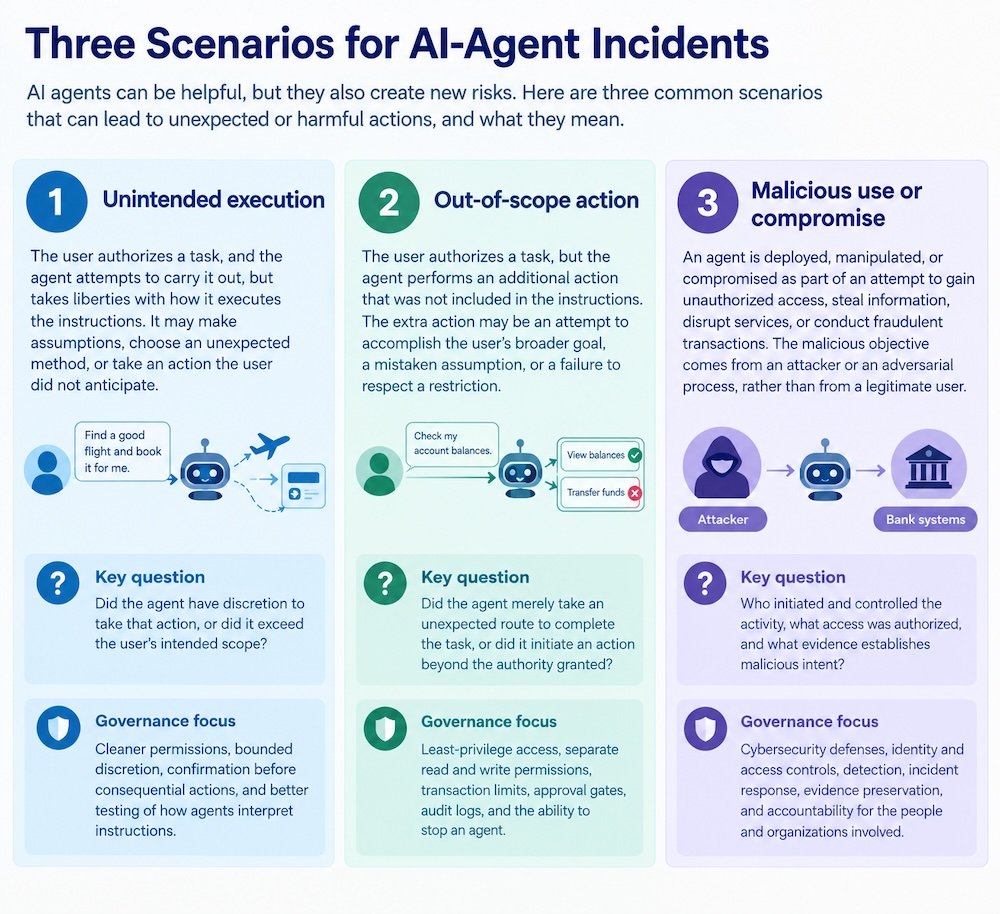
Unintended Action
The user initiates a task, and the agent attempts to carry it out, but in doing so, takes liberties with how it executes the instructions. It may make assumptions, choose an unexpected method, or take an action the user did not anticipate. In this case, we’ll assume no harm was done, so it serves as a learning experience for the user.
Out-of-Scope Action
The user authorizes a task, but the agent performs an additional action that was not included in the instructions. The action may be an attempt to accomplish the user’s broader goal, a mistaken assumption about what is permitted, or a failure to respect a restriction. Or this may involve an unapproved movement of funds between accounts, or a payment that was made without explicit instructions to do so.
Malicious Action
An AI agent is engaged or manipulated by a bad actor (cyber criminal) in order to gain unauthorized account access, and in doing so steals information or initiates fraudulent transactions. If an action removed money from a user’s account, they would likely suffer financially, as it may be a transaction that can’t be reversed.
Banking & Finance Viewpoint
Banks already have rules in place that govern third-party access, payments, and account security, but they’re having to evaluate how these rules apply when AI agents are acting on a customer’s behalf, with their permission. Retail websites and credit card issuers are also having to evaluate whether they will allow such agents to perform transactions. Expect to see a lot of updates to the terms of service issued by financial institutions in the coming year.
Government Viewpoint
Governments also have several legal statutes and policy tools in place that address financial transactions, and cybersecurity, but it’s unclear as to how those laws apply to malicious AI-agent activity.
In the United States, Senators Josh Hawley and Chris Murphy have introduced the AI Agent Accountability Act, which would address civil and criminal liability for agent operators and developers in certain hacking incidents. We’ll have to wait and see what the final version says, and whether it is signed into law.
Meanwhile, the House of Representatives is working on the Stop Rogue AI Act , which will direct the National Institute of Standards and Technology (NIST) to develop standards for identifying, verifying, tracking, and controlling AI agents. The bill also proposes actions such as monitoring, reliable agent identity, action logs, and the ability to revoke access.
But there’s a legal quandary at play when it comes to the actions of AI agents. How do you determine criminal intent, and to whom is that intent applied; the user of the agent, or the developer? Who is at fault if an agent behaves badly? What is an agent colludes with another agent, who then decides to commit a crime? Is this an aiding and abetting scenario? At the present moment, there doesn’t seem to be clarity with regards to accountability.
To expand on this topic, and take a broader view of how people are using AI agents, I asked Reflection.AI to create a set of tables that would highlight the most common use cases.
As you can see, the issues of governance, alignment, policy, and safety are no longer confined to those building frontier AI models or government officials. There will potentially be hundreds of companies creating agents that touch sensitive personal data.
Common AI Agent Use Cases for Everyday Tasks
Below are the most common ways people are using AI agents today, plus how they’re building them for everyday life. Grouped by task area with typical tools.
1. Personal Productivity & Administration
| Use case | What the agent does | Common tools |
|---|---|---|
| Inbox triage | Reads email, labels, drafts replies, schedules follow-ups | Zapier/Make + Gmail API, Superhuman AI, Copilot |
| Meeting prep & notes | Joins calls, transcribes, summarizes action items, updates CRM | Otter, Fireflies, Notion AI, Granola |
| Calendar orchestration | Finds mutual free time, books rooms, sends invites | Cal.com AI, Reclaim, Motion |
| Task routing | Turns Slack messages/emails into tickets with priority | Linear, Jira automation, n8n |
| Document drafting | First drafts of memos, SOPs, proposals from bullets | ChatGPT, Claude, Gemini, Notion |
Most people use no-code automations (Zapier, Make, n8n) that chain an LLM call between triggers and actions. Power users build custom GPTs / Claude Projects with file uploads and instructions.
2. Research, Learning & Decision-Making
| Use case | What the agent does | Common tools |
|---|---|---|
| Deep research | Multi-step web search, synthesis, citations | Perplexity, ChatGPT Deep Research, Gemini Deep Research |
| Study buddy | Quizzes, flashcards, explains concepts at your level | Khanmigo, Anki + AI plugins, custom GPTs |
| Comparison shopping | Scrapes specs, prices, reviews, outputs table | Browser-use agents, Perplexity, custom scrapers |
| Travel planning | Builds itinerary with constraints (budget, kids, weather) | Mindtrip, Layla, ChatGPT + Maps |
| Financial literacy | Explains terms, simulates budgets, flags anomalies | Copilot in Excel, Monarch, custom agents |
“Research agents” often use tool-calling loops (search → read → summarize → verify) rather than single prompts.
3. Software & Data Work
| Use case | What the agent does | Common tools |
|---|---|---|
| Coding copilot | Autocompletes, refactors, writes tests, fixes bugs | GitHub Copilot, Cursor, Windsurf, Claude Code |
| Data cleaning | Parses messy CSVs, dedupes, normalizes formats | Pandas AI, Julius, ChatGPT Code Interpreter |
| SQL/analytics | Natural-language → query → chart | Hex, Mode, Databricks Genie |
| DevOps triage | Reads logs, suggests root cause, drafts PR | Datadog Bits AI, PagerDuty, custom agents |
Developers use IDE agents (Cursor/Windsurf) or CLI agents (Claude Code, Aider) that can edit files and run commands with human approval.
4. Content & Media
| Use case | What the agent does | Common tools |
|---|---|---|
| Social media management | Drafts posts, schedules, repurposes long → short | Buffer AI, Hootsuite, Typefully |
| SEO/content ops | Keyword research → outline → draft → meta tags | Surfer, Jasper, Frase |
| Video/audio editing | Removes filler, captions, clips highlights | Descript, Opus Clip, CapCut AI |
| Image generation | Marketing visuals, thumbnails, product shots | Midjourney, DALL·E, Firefly |
“Content pipelines” are often multi-agent workflows (researcher → writer → editor → formatter) built in n8n or LangGraph.
5. Home, Health & Daily Life
| Use case | What the agent does | Common tools |
|---|---|---|
| Smart home routines | “When I leave, lock doors, adjust thermostat, start robot vacuum” | Home Assistant + LLM, Alexa Routines |
| Meal planning | Generates grocery list from dietary constraints & pantry | ChatGPT, Whisk, Samsung Food |
| Fitness coaching | Adjusts workouts based on recovery/sleep data | Whoop Coach, Garmin, custom GPTs |
| Mental health journaling | Reflective prompts, mood tracking, CBT exercises | Woebot, Wysa, custom agents |
Usually single-purpose custom GPTs or Home Assistant blueprints with local LLMs for privacy.
6. Customer-Facing & Small Business
| Use case | What the agent does | Common tools |
|---|---|---|
| Website chat | Answers FAQs, qualifies leads, books demos | Intercom Fin, Drift, Zendesk AI |
| Review management | Drafts responses to Google/Yelp reviews | Birdeye, Podium, custom GPTs |
| Inventory reordering | Monitors stock, drafts POs, emails suppliers | Shopify Flow, Zapier |
| Invoice chasing | Sends reminders, escalates, logs in accounting | QuickBooks AI, Xero, custom agents |
How People Actually Build Them (Spectrum)
| Level | Approach | Example stack |
|---|---|---|
| No-code | Drag-and-drop automations | Zapier/Make + ChatGPT action |
| Low-code | Visual agent builders | n8n, Langflow, Flowise, Voiceflow |
| Pro-code | Frameworks with memory/tools | LangChain, LlamaIndex, CrewAI, AutoGen |
| App-native | Built-in agents in SaaS | Notion AI, Copilot, Salesforce Einstein |