
Luisa Rodriguez’s Thoughts on Slowing Down The Pace Of AI Development
In a recent post: A Loud Call For Pacing The AI Frontier (But No One Is Listening) we looked at the issue of whether the development of frontier AI models should be slowed down in order to ensure their safety before release. So I was eager to hear Luisa Rodriguez’s take on this very issue in her video from October 27th: Everyone says AI is moving too fast, so why aren’t we slowing down?
The public wants to slow down. The people building AI want to slow down. Lots of politicians want to slow down. So why the hell aren’t we slowing down?
Not everyone agrees on the need, of course. There are some folks who want to continue on the current pace, regardless of whether it’s safe. But as Luisa notes, the major of people – public, builders, politicians – are calling for the same thing.
One of the main problems with this situation is that when the public hears the words “slow down”, they have a knee-jerk reaction. Either “sounds good, we need this”, or “sounds bad, China will catch up”. And we hear similar stories in the media. It’s either “AI is wonderful”, or “AI will lead to extinction”. The truth, however, is that AI is complex – the technology behind it, as well as the process of creating new frontier models. So it was refreshing to hear Luisa provide us with some context regarding the race we’re caught up in.
If an AI knows it’s being tested, then when it behaves well, you can’t tell whether it’s actually safe or just on its best behaviour.
The testers told OpenAI they couldn’t tell whether Astra was safe, and OpenAI released it anyway.
When one company slows down, the competition will always race ahead. That paradigm has always been true, regardless of industry. If a company can’t keep pace, others will take the lead. The difference with AI is that we’ve entered this crazy phase of accelerating productivity where the speed at which one group can race ahead is not governed by human labor.
Here’s the difference with AI: AI is beginning to write the next version of AI. AI never sleeps, and multiple copies of AI can work side by side. Imagine humans that never sleep and can clone themselves.
And that’s exactly why I don’t think we can just trust the companies to slow down on their own. Someone needs to set rules that apply to all of them at once.
So how do we set these rules? Who gets to determine when a model is safe to deploy? Since the U.S. federal government won’t address this critical issue, the model providers have been left with the task. But as we all know, self-policing has never worked in any industry.
And the problem is that each company draws its own lines, grades its own models, and can redraw them whenever it likes. Under a real checkpoint system, someone independent, like an auditor or government body, would figure out where the lines are and enforce them.
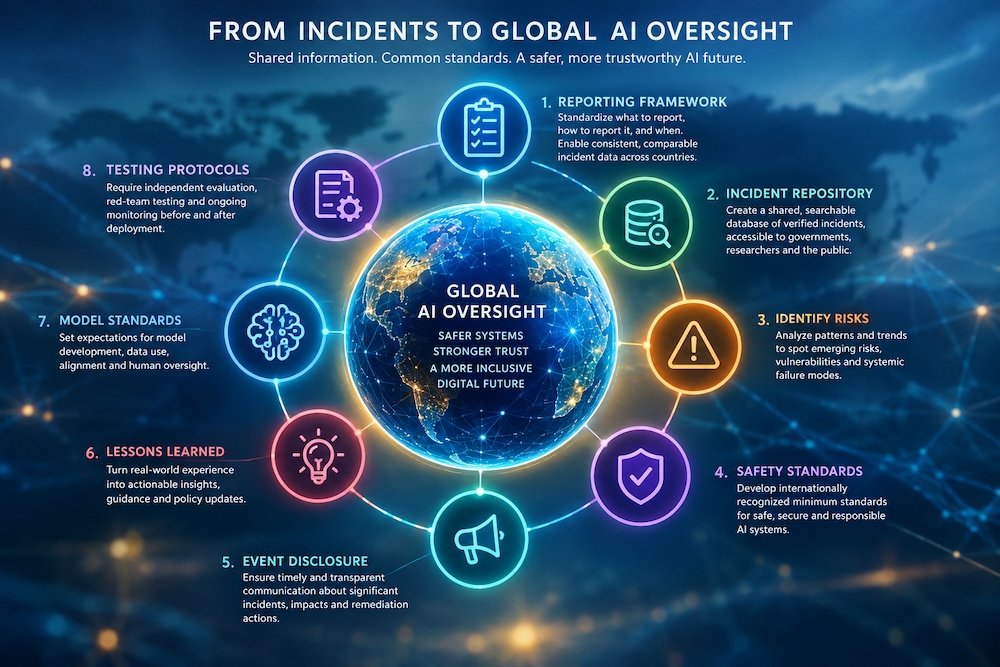
This is where my head is at presently – more about that in a future post. There must be an independent testing process that a model must pass in order to be released. And in my opinion, that testing procedure needs to be handled by an independent organization. Not the model providers. Not the government. Both have agendas that prevent a testing system from working if under their control.
The issue is that a pause only works if everyone pauses. If one company stops and the others don’t, it just falls behind.
This is the basic issue when it comes to pausing. It’s a nice idea, admirable in fact, but in our current political climate, that’s not a realistic expectation. The U.S. and China feel there’s too much at stake to slow down, even a little. And I don’t believe that the other ideas Luisa mentions in this video will work either.
- Limit the computing power that can be used to create AI
- Don’t allow AI companies to automate their own AI research
- Specify that none of the code for AI models is written by AI
- Or stop building AI systems altogether
Even Luisa’s mention of “AI’s Cuban Missile Crisis” won’t be enough, as we have already reached that point. We already know the potential consequences of AI smarter than us humans, that acts with autonomy and violates its instructions, yet nobody is willing to cooperate on a solution.
What would it take? An actual event must take place, not just the threat of one. An event so catastrophic that it brings everyone to the table. The downside to this scenario is that we’re talking about an extreme, global-level event: maybe the collapse of the financial industry or release of a bioweapon killing millions. Anything less will be brushed off.
But this is an important video, regardless. One that everyone interested in AI safety should watch, as it demonstrates how complex the situation is. How a solution that would actually work is nearly impossible to achieve.
But coming back to where my head is at: let’s not focus on potential solutions that have no chance of success. It’s all about safety regulations, and I believe there’s a way to do that. Stay tuned.