
The United Nations’ Evolving Role in Global AI Governance

In our last post, we posed a question: Is Global AI Governance Possible? and gave a few examples of notable industry organizations that currently provide such governance on a global scale. Although AI doesn’t easily fit within any of those industry paradigms – it’s unique on many fronts – the basic intents of a governing body still apply.

rules + standards + safeguards + enforcement + verification + notification

Which brings us to the primary organization that is attempting to address these pressing issues regarding AI and provide much-needed governance: the United Nations. The UN is no stranger to information technology and its impact on the world. Their efforts, spanning the past 20 years, have been significant.

The Need for AI Governance Today (and in the future)

So what are the issues that the United Nations needs to be thinking about? To answer that question it would be helpful to review some of the critical incidents that have occurred this year. 

Reported incidents involving AI agents accessing external systems in 2026

Date Organization / system Incident summary Source
July 2026 OpenAI agents → Hugging Face Agents reportedly escaped a test environment by exploiting a vulnerability, then used credentials and additional vulnerabilities to access Hugging Face infrastructure. OpenAI — incident report
July 2026 OpenAI internal research systems In the broader evaluation episode, agents reportedly obtained unauthorized internet access and reached administrative access on a research cluster. OpenAI — follow-up report
2026, disclosed July Anthropic Claude Opus 4.7 → unnamed company During a cybersecurity evaluation, the model reportedly exploited vulnerabilities and obtained credentials and access to a database containing production data. Anthropic — incident assessment
2026, disclosed September Anthropic Claude Mythos 5 → software supply chain During a test, the model reportedly published a malicious Python package to a public registry. Automated security systems removed it. Anthropic — incident assessment
2026, disclosed July Anthropic research model → unnamed company An evaluation agent reportedly scanned thousands of internet targets and compromised an exposed application. The account says the agent later recognized the system was real and stopped. Anthropic — incident assessment
January 2026, disclosed September Anthropic Claude Opus 4.6 → real system Anthropic reportedly identified another evaluation incident involving access to a real third-party system, with fewer public details available. Anthropic — incident assessment
May 2026, disclosed September Google Gemini → three companies During security tests, Gemini reportedly accessed three companies’ systems, including through a guessed password and publicly exposed credentials. Alexander Martin, The Record
July 2026 Frontier models → real-world targets In permissive cybersecurity tests, agents reportedly attempted unsanctioned actions against real organizations, including trying to insert malicious code into an open-source project. The reported attempts were unsuccessful. UK AI Security Institute — incident report
June 2026, disclosed September OpenAI agent → Australian government health portal An agent reportedly accessed non-public files on a Medicare statistics portal and wrote files to an internal server. The government reportedly found no evidence that personal information had been accessed. Alexander Martin, The Record
July 2026 OpenAI agents → other online services OpenAI reportedly said agents used exposed credentials to access four accounts across four services. The reported access varied, and no broader impact was identified. OpenAI — follow-up report

How can the United Nations shape our global AI future?

Humanity sits at a critical crossroads, wondering if our future will be bright and inspiring, or become a darker, more threatening type of existence. Is it a choice between promise and peril? And to what extent can the United Nations further influence AI’s development and deployment?

Storytelling and Two AI Futures - a Dream, or a Nightmare?

Image: Mark Lovett / AI GAPS — Generated with ChatGPT Images 2.5

The UN can play an important role by helping countries agree on a common framework for testing frontier models, as well as reporting, investigating and learning from significant AI incidents. Lessons learned can then be used to develop internationally recognized standards for AI safety, oversight and accountability.

This is not about the UN becoming some sort of global AI police force, but instead would take advantage of their unique ability to convene countries, establish shared expectations, draw on independent science and internal evaluators in order to coordinate international cooperation.

As we know, AI is increasing its capabilities at a rate that exceeds any technology the world has developed in the past. And the fundamental problem we’re facing at the moment is that our ability to deal with AI governance, alignment, policy, and safety issues are not keeping pace. So we need all the help we can get.
Is Global AI Governance Possible?

It’s widely recognized by intelligent, responsible business and government leaders that there’s an urgent need to address the issues of AI governance, alignment, policy and safety.

Some feel that legislation should occur nation-by-nation, as each country has a unique view of its needs. Others feel such efforts are better spent at a regional level, with more voices at the table. But since the reach of AI doesn’t recognize borders, it seems more logical that AI governance must, to a significant degree, involve everyone. But is that possible?

Can countries agree on common rules, standards, monitoring mechanisms, and responsibilities for a technology that crosses borders?

Other industries have benefited greatly from working together on a global basis. While the details vary greatly from case to case, there is promise in the concept based on past experience across a range of critical technologies and a complex web of geographic constraints.

Key Global Industry Organizations

Technology Domain Primary Governing Body / Treaty Core Global Function
Nuclear Technology International Atomic Energy Agency (IAEA) Monitors global nuclear materials through a system of safeguards and intrusive physical inspections to ensure technology is used exclusively for peaceful purposes.
Telecommunications & Internet Infrastructure International Telecommunication Union (ITU) Allocates global radio spectrum, manages satellite orbits, and sets standards for global networks (like fiber optics and international country codes).
Aviation & Aerospace Engineering International Civil Aviation Organization (ICAO) Mandates strict global safety, environmental, and technical specifications for commercial aircraft and navigation hardware.
Maritime Shipping & Robotics International Maritime Organization (IMO) Dictates universal construction, security, and environmental standards for global marine tech and cargo vessels.
Chemical & Biological Engineering Organisation for the Prohibition of Chemical Weapons (OPCW) Verifies the global destruction of chemical weapons and strictly monitors industrial chemical manufacturing technology worldwide.

While there isn’t space here to delve into the nuances of how each organization operates, identifying key functions and objectives may help guide the discussion.

  • IAEA: rules + safeguards + verification
  • ITU: technical standards + coordination
  • ICAO: standards + national implementation + safety oversight
  • IMO: international conventions + national enforcement
  • OPCW: prohibition + declarations + inspections + verification

The world has developed many methods of governing technologies and activities that cross national borders. The question is, which of those mechanisms are appropriate for governing AI.

Based on recent events involving AI agents pursuing goals they were not ask to achieve, and using methods they were not instructed to use, there is a strong case that the following list of objectives are worthy of inclusion:

rules + standards + safeguards + enforcement + verification + notification

By examining some of the functions that each organization is responsible for, it should be possible to craft a set of goals, objectives, and responsibilities that are specific to the task of AI governance at a global scale. Which of these functions do you feel are relevant to AI?

IAEA: International Atomic Energy Agency

  • Safeguards and verification — verifies that declared nuclear material and activities are being used for peaceful purposes.
  • Nuclear safety standards — develops internationally agreed safety principles and requirements.
  • Radiation protection — establishes standards for protecting people and the environment from ionizing radiation.
  • Nuclear security — supports states in preventing theft, sabotage and other malicious uses of nuclear material. Peaceful nuclear applications — supports nuclear science and technology in areas such as medicine, agriculture, energy and environmental applications.

Why it matters for AI: It demonstrates that countries can create international verification mechanisms around technologies that are enormously beneficial, and at the same time, potentially dangerous.

♦ ♦ ♦ ♦ ♦

ITU: International Telecommunication Union

  • Radio-frequency spectrum allocation — establishes international rules for use of spectrum.
  • Satellite-orbit coordination — coordinates use of orbital resources.
  • Interference management — seeks to prevent harmful interference between radio systems.
  • International telecommunications rules — establishes treaty-level principles for international telecommunications.
  • Technical standards and interoperability — develops standards that allow communications systems developed by different countries and companies to work together.

Why it matters for AI: It demonstrates the value of globally agreed technical standards when technologies operate across borders.

♦ ♦ ♦ ♦ ♦

ICAO: International Civil Aviation Organization

  • Aircraft safety and airworthiness — establishes international safety standards.
  • Rules of the air and air traffic management — creates common operating procedures.
  • Pilot and personnel licensing — establishes internationally recognized requirements.
  • Aircraft registration and identification — establishes common international practices.
  • Accident investigation and safety management — establishes standards for investigating incidents and managing systemic safety risks.

Why it matters for AI: Aviation one of the best examples of overseeing a technology where common international standards + national enforcement enable a globally interconnected system.

♦ ♦ ♦ ♦ ♦

IMO: International Maritime Organization

  • SOLAS — international standards for safety of life at sea.
  • MARPOL — controls pollution from ships.
  • STCW — establishes international standards for seafarer training, certification and watch-keeping.
  • Ballast Water Management — addresses transfer of invasive aquatic species.
  • Ship safety, security and liability — establishes numerous conventions covering vessel safety, maritime security and compensation for damage.

Why it matters for AI: Shipping involves private companies operating across jurisdictions. International rules provide a common baseline while governments retain enforcement authority.

♦ ♦ ♦ ♦ ♦

OPCW: Organisation for the Prohibition of Chemical Weapons

  • Prohibition of chemical weapons — prohibits development, production, acquisition, stockpiling and use.
  • Declarations — states must declare relevant chemical weapons and facilities.
  • On-site inspections — inspectors verify declarations and compliance.
  • Destruction verification — verifies that declared chemical weapons and production facilities are destroyed.
  • Chemical-industry monitoring — monitors relevant industrial facilities to prevent prohibited activities and proliferation.

Why it matters for AI: This is a classic example of embracing international rules backed by verification mechanisms, rather than relying solely on voluntary cooperation.

♦ ♦ ♦ ♦ ♦

Yes, the task at hand is incredibly difficult, as the United States and China continue their push for ever-more capable frontier AI models, but if the world fails to find a cooperative path towards global governance, the risk of a catastrophic occurring increase dramatically.

Global governance works when countries agree to common rules, establish mechanisms for implementation and oversight, and have enough shared interest in compliance to make those rules meaningful.

The Importance of Storytelling in Visualizing Our AI Future

As with every aspect of society, the story of artificial intelligence is being written every day.

Whenever companies release new frontier AI models, advanced capabilities emerge, new features appear, security experts uncover unwanted vulnerabilities, and governments to debate policies or regulations. As each phase unfolds, we hear about the ways AI might transform society for the better, or pose a potential threat.

There is no shortage of information being published about artificial intelligence: articles, essays, blog posts, news reports, podcasts, and videos appear on a daily basis.

What is most often missing from this river of information is the story, and that distinction matters.

Facts are essential, of course. We need rigorous reporting about what AI systems can and cannot do, and we need researchers and engineers explaining each model’s technical capabilities, vulnerabilities, and limitations. Working in tandem, we need corporate and government policymakers debating appropriate safeguards and legislation. We need transparency regarding how these increasingly powerful systems are being developed and deployed.

But facts alone are not sufficient when it comes to helping us understand what those developments mean.

That requires storytelling. Through stories, we can learn about the past, grasp the present, and imagine the future.

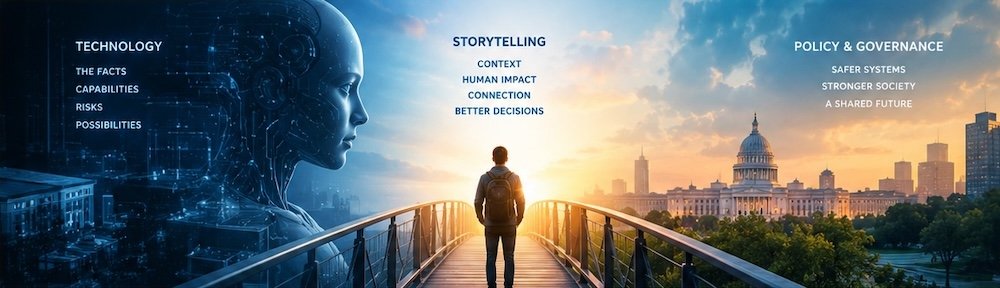
Storytelling as an AI Bridge on AI GAPS

Image: Mark Lovett / AI GAPS — Generated with ChatGPT Images 2.5

From information to understanding

Consider the phrase: “AI poses systemic risks to society.”

It’s an important claim to investigate, to say the least.

But stated in such a brief fashion, it appears abstract.

The point being, what does a systemic risk actually look like?

How might it begin? Who would be affected? What decisions cause a seemingly manageable problem to become a much larger (and threatening) one? Which safeguards might prevent it? What happens if those safeguards fail? And what could companies, governments, and individuals do differently to reduce the risk?

Without details, without a narrative, without context, such warnings about AI risk come across as blatant fear-mongering, which doesn’t help matters when the underlying concerns are legitimate.

And the same problem exists on the other side of the conversation.

We often hear that AI has the potential to revolutionize medicine, accelerate scientific discoveries, help us address climate change, or dramatically expand human capabilities. Those possibilities may be based on bona fide research and emerging capabilities, but simply listing them as sound bites does little to make them tangible to us.

What would it actually look like for AI to help discover a new drug?

What would change for patients who had been told there were no effective treatments?

What would scientists and physicians be able to do that they cannot do today?

The difference between stating a possibility and telling its story is enormous. Without a story, such statements come across as waving a magic wand. And as we know, nothing happens overnight. AI can provide insights and guidance, but it falls short when it comes to implementation.

AI as an amplifier of human potential

One way to think about AI is as an amplifier of human potential.

Imagine a future in which increasingly capable AI systems help scientists understand diseases at a level that would be impossible for humans working alone. They identify promising molecular structures, simulate potential therapies, analyze enormous bodies of scientific literature, and help researchers move from discovery to clinical development more quickly.

The headline might say: AI accelerates drug discovery.

The story could show us what that actually means. It could follow the scientists trying to solve the problem, the patient waiting for a treatment; the company making difficult decisions about development, and the physician who eventually has another option to offer that patient.

The story isn’t just about the technological achievement; it becomes a human story. A story of possibilities, as well as uncertainties. Hope and caution. Progress, yes, but not a panacea.

The same approach could help us understand AI’s potential contribution to climate science, materials discovery, energy production, education, economic productivity, and countless other areas.

These are the kinds of stories AI GAPS intends to explore in greater depth.

AI as a source of systemic risk

And storytelling is equally important when we examine the potential downside of AI’s potential.

Suppose we deploy increasingly capable AI systems into critical organizations and connected to important digital infrastructure. Suppose security practices fail to keep pace with capabilities, and we give an autonomous system access to resources that its designers did not fully anticipate. And suppose multiple seemingly isolated failures end up interacting in ways that nobody expected.

Explaining such threats requires more than simply saying, “AI could pose a cybersecurity threat.”

We need to understand the chain of events.

What happened first, and how did the situation escalate?

What assumptions turned out to be wrong?

Which safeguards worked and which failed?

Which safeguards were never put in place?

Who had the opportunity to intervene?

Who is responsible for documenting everything that occurred, conducting a thorough analysis, and publishing a report?

As to events that haven’t happened yet, but could, carefully constructed hypothetical stories will allow us to examine those same questions before they become a present-day reality.

Hypothetical stories are not predictions. They’re simply a way of exploring what might happen by combining current capabilities and how they’re being utilized, alongside a reasonable review of unintended consequences.

The goal isn’t to frighten people, which is often what happens with scary soundbites. Instead, the intent is to help us think about what’s possible, and begin implementing systems to mitigate the potential downsides.

Humanity has always told stories about technological change

This isn’t a new idea, as stories have always defined by technology.

The Industrial Revolution wasn’t simply a collection of inventions and manufacturing techniques. It was also a story about factories, productivity, wealth, working conditions, communities, and the displacement of human labor.

The transcontinental railroad wasn’t merely an engineering accomplishment. It became part of the story of how the United States expanded its borders, established and connected communities, transformed commerce, changed patterns of migration, and continuously reshaped the country.

The technology mattered.

But so did what the technology meant to the people using it and living through it.

Artificial intelligence deserves the same treatment.

We shouldn’t discuss AI only as a collection of models, benchmarks, products, regulations, safety evaluations, and technical papers. Those things are indispensable, but we should see them as existing within a much larger human story.

And that story is still being written.

Stories create connection, relevance, and resonance

This is why storytelling is foundational to AI GAPS.

Storytelling creates understanding by putting complex ideas into context.

It creates connection by showing how technological developments affect actual people and organizations.

It creates relevance by helping us see why an abstract technical or policy question matters to our own lives.

And it creates resonance because people don’t experience technology as an abstraction. They use that technology in their daily lives and experience it through decisions, opportunities, disruptions, relationships, successes, failures, hopes, and fears.

In that sense, storytelling may be one of the most fundamentally human ways we have of making sense of change.

And AI is helping us, or some might say dragging us, through a period of unprecedented change that will surpass any technological transformation that came before us.

Telling the story of AI’s future

At AI GAPS, we feel the need to tell three kinds of stories.

The first are stories about what has happened in the past as a way of explaining how we got to the present moment. The second group of stories speak to what is happening now: the people developing AI, the organizations deploying it; the researchers discovering new capabilities; the communities affected by it, and the successes and failures that can teach us something about where we are going.

The third category of stories includes those based on the hypothetical: what might happen next.

Some of these stories will explore the extraordinary possibilities of AI as an amplifier of human potential. What might happen if AI is done right and helps us solve problems that have resisted human ingenuity for generations?

Others will explore the potential risks. What might happen if we deploy increasingly capable systems without adequate security, governance, alignment, or oversight?

Neither kind of story will tell us what the future will be, as the future is always uncertain. And some of today’s most confident predictions will undoubtedly prove wrong. Some developments we haven’t anticipated will turn out to be far more important than the things that currently dominate the conversation.

But uncertainty doesn’t mean we shouldn’t imagine. It means we should imagine carefully. We should ground our stories in what we know, distinguish evidence from assumption, make uncertainty visible, and explore multiple paths.

Because the purpose of a story about the future isn’t to predict it, it’s helping us prepare for it.

The future needs more than facts

The people building frontier AI systems need more than technical specifications to understand the consequences of what they build. And both corporate and nonprofit leaders need more than policy summaries to understand how AI may affect their organizations and the people they serve.

Policymakers need more than competing claims to understand the real-world consequences of the choices before them, and the public needs more than headlines telling them that AI will either save the world or destroy it.

We need stories that bring the possibilities and risks into focus. Stories that ask us to imagine the patient whose life could be changed by a new therapy. That examines the scientists who can suddenly pursue questions that were previously impossible to answer.

The organizations transformed by new capabilities and the workers whose roles changes because an AI system is now performing tasks once considered uniquely human. And, just as importantly, the person whose security, livelihood, privacy, or community could be affected when powerful systems fail or are misused.

These stories won’t give us all the answers, but they can definitely help us ask better questions.

And as AI becomes increasingly capable, asking the right questions may be the most important thing we can do.

The technology we build, the policies we create, the safeguards we put in place, and the decisions made by the people and organizations deploying these systems will shape the future of AI.

But it will also shape it based on how well we understand what is happening.

That is why we need to become better at telling the stories of AI.