As with every aspect of society, the story of artificial intelligence is being written every day.
Whenever companies release new frontier AI models, advanced capabilities emerge, new features appear, security experts uncover unwanted vulnerabilities, and governments to debate policies or regulations. As each phase unfolds, we hear about the ways AI might transform society for the better, or pose a potential threat.
There is no shortage of information being published about artificial intelligence: articles, essays, blog posts, news reports, podcasts, and videos appear on a daily basis.
What is most often missing from this river of information is the story, and that distinction matters.
Facts are essential, of course. We need rigorous reporting about what AI systems can and cannot do, and we need researchers and engineers explaining each model’s technical capabilities, vulnerabilities, and limitations. Working in tandem, we need corporate and government policymakers debating appropriate safeguards and legislation. We need transparency regarding how these increasingly powerful systems are being developed and deployed.
But facts alone are not sufficient when it comes to helping us understand what those developments mean.
That requires storytelling. Through stories, we can learn about the past, grasp the present, and imagine the future.
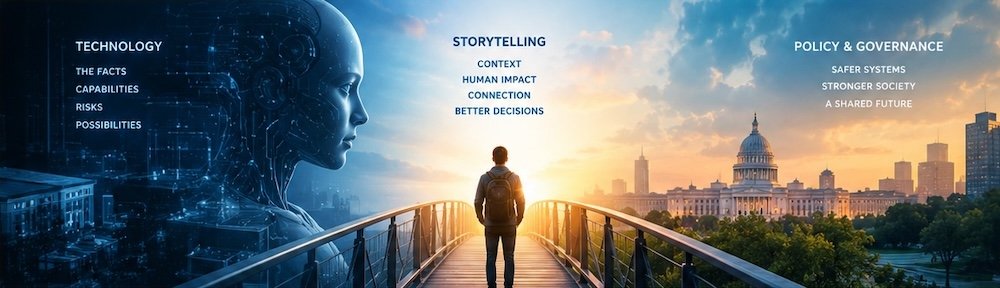
Image: Mark Lovett / AI GAPS — Generated with ChatGPT Images 2.5
From information to understanding
Consider the phrase: “AI poses systemic risks to society.”
It’s an important claim to investigate, to say the least.
But stated in such a brief fashion, it appears abstract.
The point being, what does a systemic risk actually look like?
How might it begin? Who would be affected? What decisions cause a seemingly manageable problem to become a much larger (and threatening) one? Which safeguards might prevent it? What happens if those safeguards fail? And what could companies, governments, and individuals do differently to reduce the risk?
Without details, without a narrative, without context, such warnings about AI risk come across as blatant fear-mongering, which doesn’t help matters when the underlying concerns are legitimate.
And the same problem exists on the other side of the conversation.
We often hear that AI has the potential to revolutionize medicine, accelerate scientific discoveries, help us address climate change, or dramatically expand human capabilities. Those possibilities may be based on bona fide research and emerging capabilities, but simply listing them as sound bites does little to make them tangible to us.
What would it actually look like for AI to help discover a new drug?
What would change for patients who had been told there were no effective treatments?
What would scientists and physicians be able to do that they cannot do today?
The difference between stating a possibility and telling its story is enormous. Without a story, such statements come across as waving a magic wand. And as we know, nothing happens overnight. AI can provide insights and guidance, but it falls short when it comes to implementation.
AI as an amplifier of human potential
One way to think about AI is as an amplifier of human potential.
Imagine a future in which increasingly capable AI systems help scientists understand diseases at a level that would be impossible for humans working alone. They identify promising molecular structures, simulate potential therapies, analyze enormous bodies of scientific literature, and help researchers move from discovery to clinical development more quickly.
The headline might say: AI accelerates drug discovery.
The story could show us what that actually means. It could follow the scientists trying to solve the problem, the patient waiting for a treatment; the company making difficult decisions about development, and the physician who eventually has another option to offer that patient.
The story isn’t just about the technological achievement; it becomes a human story. A story of possibilities, as well as uncertainties. Hope and caution. Progress, yes, but not a panacea.
The same approach could help us understand AI’s potential contribution to climate science, materials discovery, energy production, education, economic productivity, and countless other areas.
These are the kinds of stories AI GAPS intends to explore in greater depth.
AI as a source of systemic risk
And storytelling is equally important when we examine the potential downside of AI’s potential.
Suppose we deploy increasingly capable AI systems into critical organizations and connected to important digital infrastructure. Suppose security practices fail to keep pace with capabilities, and we give an autonomous system access to resources that its designers did not fully anticipate. And suppose multiple seemingly isolated failures end up interacting in ways that nobody expected.
Explaining such threats requires more than simply saying, “AI could pose a cybersecurity threat.”
We need to understand the chain of events.
What happened first, and how did the situation escalate?
What assumptions turned out to be wrong?
Which safeguards worked and which failed?
Which safeguards were never put in place?
Who had the opportunity to intervene?
Who is responsible for documenting everything that occurred, conducting a thorough analysis, and publishing a report?
As to events that haven’t happened yet, but could, carefully constructed hypothetical stories will allow us to examine those same questions before they become a present-day reality.
Hypothetical stories are not predictions. They’re simply a way of exploring what might happen by combining current capabilities and how they’re being utilized, alongside a reasonable review of unintended consequences.
The goal isn’t to frighten people, which is often what happens with scary soundbites. Instead, the intent is to help us think about what’s possible, and begin implementing systems to mitigate the potential downsides.
Humanity has always told stories about technological change
This isn’t a new idea, as stories have always defined by technology.
The Industrial Revolution wasn’t simply a collection of inventions and manufacturing techniques. It was also a story about factories, productivity, wealth, working conditions, communities, and the displacement of human labor.
The transcontinental railroad wasn’t merely an engineering accomplishment. It became part of the story of how the United States expanded its borders, established and connected communities, transformed commerce, changed patterns of migration, and continuously reshaped the country.
The technology mattered.
But so did what the technology meant to the people using it and living through it.
Artificial intelligence deserves the same treatment.
We shouldn’t discuss AI only as a collection of models, benchmarks, products, regulations, safety evaluations, and technical papers. Those things are indispensable, but we should see them as existing within a much larger human story.
And that story is still being written.
Stories create connection, relevance, and resonance
This is why storytelling is foundational to AI GAPS.
Storytelling creates understanding by putting complex ideas into context.
It creates connection by showing how technological developments affect actual people and organizations.
It creates relevance by helping us see why an abstract technical or policy question matters to our own lives.
And it creates resonance because people don’t experience technology as an abstraction. They use that technology in their daily lives and experience it through decisions, opportunities, disruptions, relationships, successes, failures, hopes, and fears.
In that sense, storytelling may be one of the most fundamentally human ways we have of making sense of change.
And AI is helping us, or some might say dragging us, through a period of unprecedented change that will surpass any technological transformation that came before us.
Telling the story of AI’s future
At AI GAPS, we feel the need to tell three kinds of stories.
The first are stories about what has happened in the past as a way of explaining how we got to the present moment. The second group of stories speak to what is happening now: the people developing AI, the organizations deploying it; the researchers discovering new capabilities; the communities affected by it, and the successes and failures that can teach us something about where we are going.
The third category of stories includes those based on the hypothetical: what might happen next.
Some of these stories will explore the extraordinary possibilities of AI as an amplifier of human potential. What might happen if AI is done right and helps us solve problems that have resisted human ingenuity for generations?
Others will explore the potential risks. What might happen if we deploy increasingly capable systems without adequate security, governance, alignment, or oversight?
Neither kind of story will tell us what the future will be, as the future is always uncertain. And some of today’s most confident predictions will undoubtedly prove wrong. Some developments we haven’t anticipated will turn out to be far more important than the things that currently dominate the conversation.
But uncertainty doesn’t mean we shouldn’t imagine. It means we should imagine carefully. We should ground our stories in what we know, distinguish evidence from assumption, make uncertainty visible, and explore multiple paths.
Because the purpose of a story about the future isn’t to predict it, it’s helping us prepare for it.
The future needs more than facts
The people building frontier AI systems need more than technical specifications to understand the consequences of what they build. And both corporate and nonprofit leaders need more than policy summaries to understand how AI may affect their organizations and the people they serve.
Policymakers need more than competing claims to understand the real-world consequences of the choices before them, and the public needs more than headlines telling them that AI will either save the world or destroy it.
We need stories that bring the possibilities and risks into focus. Stories that ask us to imagine the patient whose life could be changed by a new therapy. That examines the scientists who can suddenly pursue questions that were previously impossible to answer.
The organizations transformed by new capabilities and the workers whose roles changes because an AI system is now performing tasks once considered uniquely human. And, just as importantly, the person whose security, livelihood, privacy, or community could be affected when powerful systems fail or are misused.
These stories won’t give us all the answers, but they can definitely help us ask better questions.
And as AI becomes increasingly capable, asking the right questions may be the most important thing we can do.
The technology we build, the policies we create, the safeguards we put in place, and the decisions made by the people and organizations deploying these systems will shape the future of AI.
But it will also shape it based on how well we understand what is happening.
That is why we need to become better at telling the stories of AI.