
Rules and Regulations of AI Policy
AI policy encompasses the laws, regulations, standards, and public strategies that governments and institutions adopt to shape how artificial intelligence is developed and used. It translates broad societal goals into concrete requirements that developers and deployers must meet, such as transparency, testing, and accountability.
These policies seek to mitigate the potential harms associated with AI systems. Policy gives teeth to AI governance, channels resources toward AI safety, and creates the incentives and constraints that make AI alignment achievable at scale, as new frontier models continue to roll out.
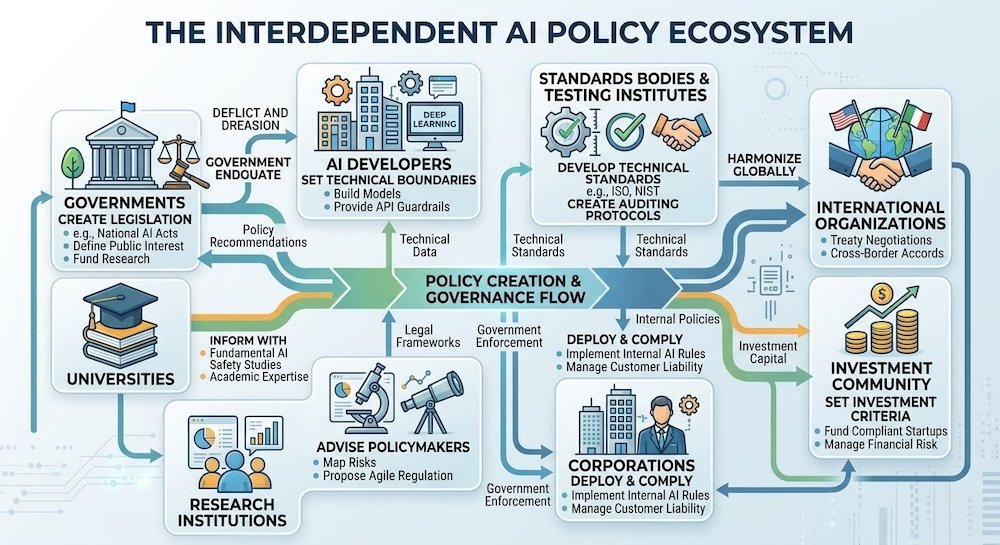
Image: Mark Lovett / AI GAPS — Generated with Gemini 3.8 Flash
1. AI Developers
- Policy Engagement: Shape technical and operational boundaries by lobbying for rules that favor scalable innovation while defining internal acceptable-use policies for their APIs and models.
- Key Policy Objectives: Protecting intellectual property rights in training data, preventing rigid liability for foundational model outputs, and advocating for pro-innovation regulatory sandboxes.
- Policy vs. Governance Link: Developers use policy to define terms of service and acceptable model usage, which feeds into governance mechanisms like API filtering, rate-limiting, and automated safety classifiers.
2. Governments
- Policy Engagement: Act as the primary architects of statutory AI policy, drafting national legislation, issuing executive directives, and providing public procurement rules that dictate state-sanctioned boundaries for AI development.
- Key Policy Objectives: Securing national security advantages, protecting citizens from civil rights violations, managing workforce disruptions, and establishing export controls on advanced compute hardware.
- Policy vs. Governance Link: Governments set binding national policies, which require organizations to implement rigorous internal governance programs, such as risk management systems and conformity assessments, to prove compliance.
3. Corporations
- Policy Engagement: Formulate internal corporate acceptable-use policies for employees and customers while sometimes lobbying policymakers to water down burdensome compliance duties or secure favorable liability caps.
- Key Policy Objectives: Managing enterprise risk, protecting proprietary data privacy, preventing brand damage from biased outputs, and avoiding steep regulatory fines.
- Policy vs. Governance Link: Corporations establish internal company-wide AI policies regarding what tools employees can use, while their governance structure enforces those rules through technical logging, access controls, and human-in-the-loop review boards.
4. International Organizations
- Policy Engagement: Develop cross-border normative frameworks, treaties, and non-binding declarations that bridge geopolitical divides and encourage cooperative multi-state policy alignment.
- Key Policy Objectives: Harmonizing global definitions of risk, preventing a race to the bottom in safety standards that increase risks, and addressing borderless existential threats, such as biosecurity, cyber security, or autonomous systems.
- Policy vs. Governance Link: International bodies issue high-level policy principles, such as the OECD AI Principles, that individual states translate into domestic legislative governance obligations.
5. Standards Bodies and Testing Institutes
- Policy Engagement: Translate broad government policy mandates into precise, operational, and technical specifications that industries can objectively measure and certify against.
- Key Policy Objectives: Establishing interoperability, creating repeatable benchmarks for bias and robustness, and providing auditable frameworks, such as ISO/IEC 42001 or NIST guidelines.
- Policy vs. Governance Link: When laws establish a policy requirement for trustworthy AI, standards bodies provide the concrete governance tools, such as auditing templates and risk management metrics, that are needed to satisfy that policy.
6. Universities
- Policy Engagement: Inform public policy through empirical evidence, peer-reviewed research on AI safety, and expert testimony to legislative committees.
- Key Policy Objectives: Safeguarding academic freedom, securing public and private research funding, and studying the long-term societal and ethical impacts of AI deployment.
- Policy vs. Governance Link: Academic research produces the foundational risk assessments and capability evaluations that policymakers use to write effective laws and corporations use to shape internal governance.
7. Research Institutions
- Policy Engagement: Draft white papers, policy briefs, and actionable recommendations that directly influence legislative agendas and regulatory oversight.
- Key Policy Objectives: Mapping regulatory blind spots, tracking global AI incidents, and proposing agile, adaptive policy designs that keep pace with technological cycles.
- Policy vs. Governance Link: Think-tank policy proposals provide the blueprint for new governance structures, helping organizations translate abstract ethical concepts into operational compliance regimes.
8. Investment Community
- Policy Engagement: Shape market-level policy implicitly through capital allocation. For example, rewarding startups that build compliance-ready architectures or penalizing those that ignore risk.
- Key Policy Objectives: Maximizing return on investment while mitigating regulatory compliance risks that could devalue portfolio companies.
- Policy vs. Governance Link: Investors implement policies, such as ESG or safety criteria in term sheets, that force early-stage startups to adopt proactive AI governance long before government regulators step in.
Summary
Not only are AI policies generated by a range of stakeholders, but the objectives of those policies are not necessarily in alignment. Some prioritize safety, while others place financial incentives on top, or seek to reduce the effectiveness of the policies generated by other parties. With every AI policy, it’s important to think about the desired outcome.
Additional Resources
The AI Policy Podcast – Center for Strategic & International Studies
What are AI Policy Areas? – WashU Law
How to create an AI policy employees can follow – Microsoft