
The Critical Nature of AI Governance
With AI infiltrating every aspect of life, questions often arise around who calls the shots regarding how artificial intelligence is developed and deployed in a safe manner. That’s where governance comes in. AI governance refers to the many systems, institutions, and processes by which decisions about artificial intelligence are made, monitored, and held accountable. The goal is to make sure those who build and deploy AI are answerable to the public and to the values society chooses to uphold.
Beyond the rules and regulations, governance also deals with who has a seat at the table, how power is distributed, and how we course-correct when things go wrong. In this sense, governance is the framework giving AI policy its authority, creating the conditions for genuine AI alignment, and ensuring that AI safety is treated as an ongoing responsibility rather than a one-time check.
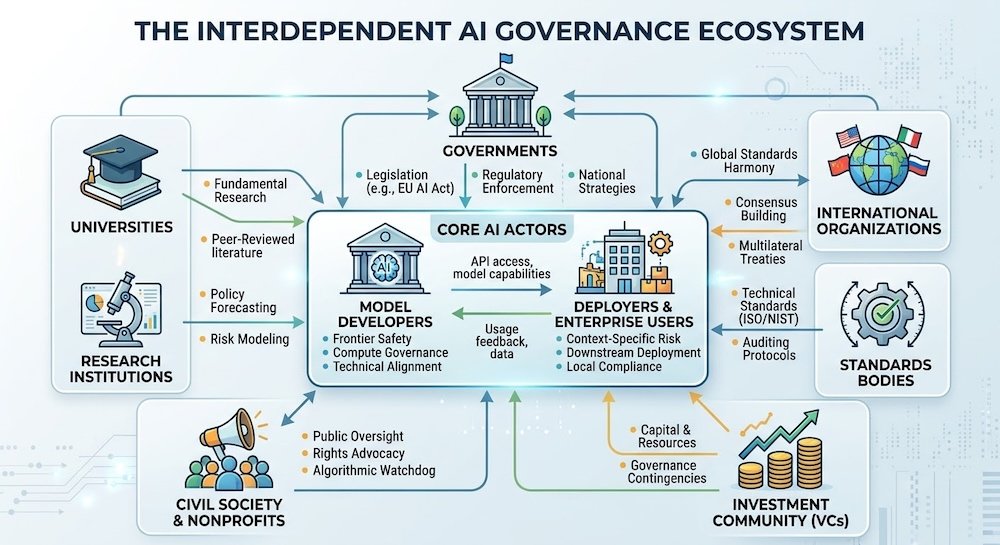
Image: Mark Lovett / AI GAPS — Generated with Gemini 3.8 Flash
How does governance happen? Sadly, there is no single entity that oversees AI Governance. Instead, responsibilities are spread across a range of players, each with different strengths and weaknesses, levels of power and influence, as well as keen insights and blind spots.
AI Developers
- Role: Research, train, fine-tune, and release foundational models, including frontier proprietary models, multimodal systems, and open-source / open-weight models.
- Responsibilities: Managing frontier safety risks (such as alignment failures), compute governance, curating training data provenance, publishing model cards, and running pre-deployment red teaming exercises.
- Techniques: Alignment training, frontier safety evaluations, capability scaling limits, data filtering pipelines, and tiered access APIs.
- Shortcomings & Blind Spots:
Compute Centralization: Safety decisions are concentrated in a handful of well-funded labs, leaving public interest groups out of foundational choices.
Unforeseen Emergent Behaviors: Developers often struggle to fully predict or interpret capabilities that emerge spontaneously at scale.
Governments
- Role: Enact legislation and legal frameworks, enforce compliance, protect national security, and safeguard citizen rights.
- Responsibilities: Passing comprehensive AI laws, regulating high-risk sectors (healthcare, defense, finance), funding public-sector safety research, and setting national AI strategies.
- Techniques: Statutory legislation, executive orders, regulatory enforcement, antitrust actions, public procurement mandates, and establishment of national AI safety institutes.
- Shortcomings & Blindspots:
Legislative Lead Time: Traditional lawmaking is often too slow to keep pace with exponential advancements in machine learning.
Geopolitical Fragmentation: Patchworks of conflicting national laws create compliance issues and “race-to-the-bottom” regulatory havens that circumvent laws.
Technical Literacy: Lawmakers frequently lack deep technical expertise and respond to fears and hype, leading to loopholes, misguided legislation or overly broad definitions.
Corporations
- Role: Integrate pre-trained or commercial AI models into industry workflows, customer-facing products, or internal business operations.
- Responsibilities: Conducting impact assessments, ensuring sector-specific compliance (health, legal, finance), managing human-in-the-loop oversight, and preventing downstream misuse or hallucination-induced harm.
- Techniques: Additional guardrails, content moderation filters, post-deployment auditing, and employee training on human oversight.
- Shortcomings & Blind Spots:
The “Black Box” Dependency: Corporations often rely on APIs or black-box models managed by external developers, making it difficult to remediate architectural biases or safety flaws.
Passing the Buck: Enterprises frequently over-rely on vendor safety claims without performing adequate local testing or validation for their specific operational contexts.
International Organizations
- Role: Foster cross-border cooperation, harmonize global standards, and address transnational risks such as biosecurity threats or autonomous weapons.
- Responsibilities: Drafting global declarations, treaties, and non-binding normative frameworks.
- Techniques: Multilateral summits, treaty negotiations, global monitoring reports, and diplomatic consensus-building.
- Shortcomings & Blind Spots:
Lack of Enforcement: Most international agreements rely on voluntary compliance and lack punitive enforcement mechanisms.
Geopolitical Gridlock: Deep divisions between superpowers stall meaningful global treaties.
Exclusion: Smaller nations and marginalized populations are frequently underrepresented in standard-setting rooms.
Standards Bodies and Testing Institutes
- Role: Translate broad ethical principles into precise, measurable, and technically rigorous benchmarks.
- Responsibilities: Developing technical standards for interoperability, safety, security, and transparency.
- Techniques: Consensus-driven technical specifications, benchmark datasets, standardized stress-testing protocols, and third-party auditing certifications.
- Shortcomings & Blind Spots:
Pace of Innovation: It can be difficult for the standardization processes to keep pace with the rate of AI development, potentially rendering technical benchmarks obsolete by the time they are finalized.
Industry Capture: Standards run the risk of being dominated by large technology corporations that have the resources to send representatives, potentially skewing standards in their favor or lightening restrictions.
Universities
- Role: Conduct fundamental research, train the next generation of researchers, and maintain critical scientific independence from governments and AI developers.
- Responsibilities: Exploring foundational safety problems, such as alignment and interpretability, publishing peer-reviewed literature, and critiquing industry safety claims.
- Techniques: Empirical studies, theoretical model analysis, peer review, independent testing and evaluation of AI models, and open-source software development.
- Shortcomings & Blindspots:
Resource Disparity: Academic labs struggle to compete with industry financial resources, leading to a loss of top talent to the private sector.
Ivory Tower Syndrome: Academic research can be disconnected from real-world challenges.
Research Institutions
- Role: Bridge the gap between theory and policy by providing rigorous, independent analysis of societal impacts.
- Responsibilities: Conducting policy forecasting, evaluating systemic risks, mapping governance gaps, and advising governments and international bodies.
- Techniques: Scenario planning, white papers, policy briefs, public datasets tracking AI incidents, and quantitative risk modeling.
- Shortcomings & Blind Spots:
Funding Dependencies: Think tanks are often reliant on philanthropic grants or corporate tech funding, which can introduce subtle biases or self-censorship based on the viewpoints of certain donors.
Echo Chambers: Policy recommendations can sometimes circulate within elite expert networks without grounding in public realities.
Investment Community
- Role: Investors, such as venture capitalists and private equity funds, act as the gatekeepers of capital, deciding which AI architectures, startups, and safety approaches receive funding.
- Responsibilities: Conducting pre-investment due diligence, managing financial risk, and increasingly setting operational conditions for portfolio companies.
- Techniques: Term sheets with governance contingencies, investor influence on corporate boards, and Environmental, Social, and Governance (ESG) screening.
- Shortcomings & Blind Spots:
Growth-at-All-Costs Mentality: Investors often prioritize rapid growth over deliberate safety pacing, often actively discouraging detailed safety audits if they run the risk timely product release.
Lack of Safety Expertise: Investment decisions are traditionally driven by financial returns rather than deep technical insight into catastrophic AI risks or systemic societal harms.
Summary
AI governance is a sprawling ecosystem of checks and balances where no single actor can manage the risks alone. While those building AI systems push forward at a rate that outpaces oversight capability, our governments, standards bodies, and researchers create the friction that keeps innovation and safety aligned. A mature governance framework depends on continuous feedback loops across all these tiers.
Additional Resources
Security & AI Governance: Reducing Risks in AI Systems – IBM Technology
AI Governance Framework 2026: The Five Layer Stack – Tech Explained
AI Governance Foundations – Safeshield Training (fourteen part series)