
Luisa Rodriguez Explains Why This Is “The Scariest AI Report I’ve Ever Seen”

After all the crazy AI hacking events that occurred during the first half of 2026, Anthropic made the bold decision to allow staff from METR (Model Evaluation & Threat Research) into their facility to evaluate the rate of progress they’ve been experiencing in the development of their new frontier AI models.

From August 12 to October 29, 2026, METR staff performed a high-access evaluation at Anthropic to assess the degree to which AI is accelerating AI R&D. ~METR

On November 5, 2026, they issued their findings: Independent Assessment of AI R&D Acceleration at Anthropic in October 2026, and while there were significant limitations in play – limited access to company information and redactions to the final report – the overall message was sobering, if not downright frightening. Yet it caused barely a ripple in public discourse.

While the full report is well worth a read, most people don’t have the time or the level of interest in AI safety to make it to the end. But if you want to know what the report means, and hear about the warnings regarding where we’re headed, give a listen to Luisa Rodriguez’s insights on the matter. One that she frames as: The Scariest Report I’ve Ever Seen.

This is how Luisa opens her talk as a way to set the stage for her message:

METR, an independent group that assesses AI risk, spent 11 weeks going through Anthropic’s internal data. They found Anthropic is now improving its AI about twice as fast as it was a year ago. And the main reason seems to be that its AI is helping build the next version of itself.

On many occasions I’ve mentioned the fact that frontier AI models have been improving far faster that safety and alignment engineers are able to deal with. And this fact is at the center of METR’s evaluation.

AI experts have been warning about this for years, and there’s a term for it. It’s called recursive self-improvement, and if METR’s right, Anthropic might be on the cusp of it right now. Some of those experts thought this was further off. This report changed their minds.

So, on the one hand, hats off to Anthropic for allowing METR to conduct their research, but if you’re hoping for a thorough investigation leading to a report containing all the facts, that is not what happened – not at all. And that’s why this report is so scary, to echo Luisa.

But Anthropic redacted most of the reasoning behind that number in the public report, including the majority of the evidence that METR found most convincing. METR admits this means we have to rely on their judgement much more than would be ideal.

So what does the future hold in regard to the speed of change occurring inside the AI labs? We’re all used to dealing with speed limits. Modern cars top out at about 120 mph, and passenger planes typically cruises at speeds between 550 and 580 mph. But the speed at which AI is improving doesn’t have such a limit. At least not one that researchers and evaluators can calculate with certainty.

Their picture changed several times as they got more information. But METR says they can’t rule out things getting a lot faster in the next six months. They even say the speed-up itself could be increasing. If the speed-up does keep climbing, then two years of progress in one year could become two years of progress in six months, then three months, then six weeks.

Take a moment to think deeply about this last line, while considering the fact that these RSI processes can, in theory, run continuously. No breaks. No sleep. Here’s another way to look at it. We all have smartphones, and each year, a new model comes out. Even that pace is difficult to keep up with, which is why most of us skip models and only upgrade every 2 to 3 years.

Now, imagine the smartphone release cycle shortening to every 6 months, then every 3 months. Think about that: new iPhones hitting the market every 90 days, with each new model far more capable than the last. That’s hard to grasp, but it happens to be where we’re heading with frontier AI models and RSI. Let’s review that paradigm through the lens of the 4 Pillars of AI.

Key Insights

  • Governance: External safety audits currently rely on corporations granting permission, which creates a conflict of interest where the companies being audited are free to redact sensitive findings or restrict access to protect commercial interests.
  • Alignment: The feedback loop of recursive self-improvement means human researchers are increasingly removed from direct code generation and ideation, and possibly alignment processes, with models handling end-to-end development tasks at unprecedented speeds.
  • Policy: Because competitive market dynamics prevent individual AI labs from unilaterally pausing research to prioritize safety, binding legislative measures and mandatory disclosure laws at a national or global level are required.
  • Safety: Exponential acceleration mimics fast-moving systemic crises (such as the early days of a pandemic spread), where trends initially appear manageable until safety buffers are completely overwhelmed and problems are spreading faster than solutions.

Key Takeaways

  • Recursive Self-Improvement is Underway: Approximately 80% of Anthropic’s recent speed-up is attributed to its AI models assisting researchers with coding, experimentation, and training pipelines.
  • Reaching the Threshold: Anthropic’s internal data and recent IPO filings confirm it has crossed its self-imposed safety threshold of compressing two years of research progress into a single year, yet are still evaluating next steps.
  • The Verification Crunch: Each iteration of self-improving AI leaves less time for safety researchers to verify alignment and security before the model participates in building its successor.
  • Limitations of Voluntary Audits: While Anthropic deserves credit for inviting METR into the company, the terms, access levels, and final redactions were entirely controlled by Anthropic, highlighting the systemic flaws of voluntary corporate oversight instead of fully independent auditing.
  • Policy Intervention Needed: Because competitive pressures prevent frontier AI labs from slowing down voluntarily, legislators and policy experts are calling for mandatory reporting and legal limits on fully automated AI research.

As to those redactions…

It’s a common practice for companies to protect their intellectual property at all costs, especially anything that would allow competitors to copy their processes. But it’s impossible to provide an honest evaluation of those critical processes if vital information is withheld from the auditors or redacted from a final report.

While we were able to freely share our highest-level conclusions about risk, Anthropic redacted a majority of the evidence we found most informative for these conclusions. Anthropic described the redactions as “aimed at removing confidential information that could accelerate other AI developers.” ~METR

With an additional reference note from METR:

We agree that Anthropic’s redactions were limited to confidential information that could potentially accelerate other AI developers, though most of the redacted information was very high-level. We do not make a comment on whether these redactions were justified overall, since we do not think METR is well positioned to weigh a company’s business interest in preserving this confidential information against the public’s interest in better understanding the risks from AI development. ~METR

Intellectual property is important, and there should be some safeguards in place to mitigate such disclosures, but there should be a balance between privacy and safety. And no AI developer should be the arbiter of the information they share with the public. That needs to be in the hands of an oversight entity that is only beholding to the public, not to corporate interests.

So at an absolute minimum, every frontier company should have to report how much AI is speeding up its own research, and have someone independent check what they say.

Why not require quarterly audits and reports on AI safety at every frontier lab, with no limits as to what information is reviewed or redactions in final reports. And require human-in-the-loop AI development at all times. In other words, no autonomous recursive self-improvement allowed. Just a thought…
What Rogue AI Bot Swarms Reveal About Losing Control

In a very real sense, the four pillar of AI – Governance, Alignment, Policy, Safety – apply to any technology, and they all revolve around the concept of control. And if society ever loses control of a particular technology, these four issues become impossible to maintain. Which is why so many experts have been advocating for national and global regulations that can ensure humans remain in control of AI (artificial intelligence) as it reaches AGI (artificial general intelligence) and then proceeds towards ASI (artificial super intelligence).

The topic of maintaining control over the current and upcoming iterations of AI has often been in the news, but society can’t seem to arrive at a consensus on a path moving forward. As a professor of physics at the Massachusetts Institute of Technology, author, machine learning researcher, and co-founder of the Future of Life Institute, Max Tegmark brings a unique perspective to the subject.

In this illuminating interview with Gus Docker of the Future of Life Podcast, Max shares his insights on where we stand – this control debate is not in the future, it’s in the past – and the imperative that humans remain in charge. But, as we all know, the rate of change in AI’s abilities exceeds the rate of our understanding.

This is quite difficult to deal with and to handle for the public, I think, just because the public understanding of what’s happening is quite far behind and the pace of development here is insane. ~Gus Docker

As the United States continues into the future lacking leadership or enforceable legislation at the federal level, frontier AI providers are left to their own devices when it comes to AI safety. We commonly hear about the rules and regulations associated with the FDA or FAA that are focused on safety, but there’s nothing similar for AI. Max illustrates that point with a what if story.

So I think it’s interesting to do the thought experiment: What if the US government had found out that there were 1,200 North Korean super-hackers—people who were among the world’s best hackers—and they were working in a warehouse in California doing international cybercrime? What would have happened?

Would they have sent in a SWAT team? Probably.

Would they have arrested a bunch of people?

Would they have confiscated evidence?

Launched a federal investigation? Almost certainly. ~Max Tegmark

It’s this acceleration in model capability that is uncanny, as no technology in the past has advanced so quickly and possessed such power to touch every aspect of the planet’s digital infrastructure. AI researchers and sci-fi novels have often predicted such scenarios, but the general feeling was that such events would happen far into the future. But as Max notes, it’s coming at us faster than we ever imagined. And whatever the pace today, it will increase tomorrow.

The first conclusion is: since what has happened now, in the last half year, would have sounded like total science fiction four years ago, we should expect that what can happen four years from now will feel like science fiction to us. So we have to be really humble here and not reject things just because they sound like sci-fi. ~Max Tegmark

One common story regarding rogue AI agents is that they can escape from a controlled environment, as they did with the OpenAI/Hugging Face hack, and decide to use methods they were never trained on nor told to use in order to achieve their goal. This is where agency comes into play. Standard programs have no ability to think and decide, but AI does. This trait of AI agency is not dissimilar to how humans act. In many situations we do exactly what we are told, but other times, we do whatever it is we feel like doing, regardless of whether it violates a rule or social norm.

So now you have, all of a sudden, this untethered, human-free international crime gang of AI bots that are just committing whatever crimes give them the most money the fastest—ideally without getting caught too soon—and making copies of themselves to all these different countries, running on server centers in India and China and America. And no one can stop them if they’re smart enough. ~Max Tegmark

I think it’s when Max says, ”they can hop at the speed of light from one country to another country” that we get a feel for their superpower. Criminals that walk, drive, or even fly can be tracked rather easily. But an agent moving at the speed of light – that’s a different sort of challenge. Millions of servers around the world could potentially serve as a host for rogue agents. But that costs money. Even a rogue AI agent would most likely need to rent GPUs to stay alive.

Cybersecurity Ventures estimates that cybercrime cost the world $10.5 trillion annually in 2025, up from $3 trillion in 2015 — growth of roughly 15% a year. If it were a country, cybercrime would rank as the world’s third-largest economy after the US and China. The same forecast expects costs to reach $12.2 trillion by 2031. ~Computer Crime Research Center

So what could these agents do if they formed a cybercrime cartel? Current stats on human cybercrime do vary, but these numbers from the Computer Research Center are fairly standard. Now, consider the fact that AI agents are smarter and faster than human criminals, and they continue to improve their skills on a daily basis. A swarm of agents can live a long time on $10 trillion. And beyond renting GPUs, they could also ‘rent’ humans to do work for them.

We already know that even today’s best AI is capable of helping a lot with AI development. Anthropic and OpenAI are very aggressively leaning into recursive self-improvement for just that reason, right? So clearly, this AI crime cartel would also do recursive self-improvement to be able to make more money and so on. And that’s where the next really dangerous stuff happens.~Max Tegmark

While the interview continues on with a number of valuable insights, I’ll leave it to you to complete. But I couldn’t resist adding one more remark from Max, as the topic of RSI (recursive self-improvement) is often in the headlines. For the most part, the public’s focus has been on the frontier AI model providers, and that makes sense as having AI models that can improve themselves without human intervention presents many formidable risks. But the problem is these agents may very well follow suit, creating cartels that continue to sharpen their skills faster than we can monitor them.

International Dialogues on AI Safety

Thought Leaders Convene

The International Dialogues on AI Safety (IDAIS) creates a series of international meetings where scientists and governance experts discuss risks from advanced AI and ways to reduce them. Its policy work focuses on AI safety research, plus testing and evaluation, domestic governance, and international cooperation.

As an adjunct to the recent article on Open Letters, Declarations, and Pledges Demanding Safe AI Deployment, papers produced at the IDAIS meetings bring attention to the urgent need for AI governance, alignment, policy, and safety. Read these documents in their entirety to get a better sense of what these AI leaders have been thinking year by year. The tension rises much faster than government efforts to address the potential problem of uncontrolled AI.

Meeting Statements

London Statement – IDAIS – London, UK, April 19, 2026

We recommend states recognise the common threat posed by the proliferation of AI-enabled cyberattack and biological misuse capabilities and commit to prevention efforts.

Shanghai Statement – IDAIS – Shanghai, China, July 25, 2025

We emphasise: some AI systems today already demonstrate the capability and propensity to undermine their creators’ safety and control efforts.

Venice Statement – IDAIS – Venice, Italy, September 8, 2024

The global nature of AI risks makes it necessary to recognize AI safety as a global public good.

Beijing Statement – IDAIS – Beijing, China, March 11, 2024

In the depths of the Cold War, international scientific and governmental coordination helped avert thermonuclear catastrophe. Humanity again needs to coordinate to avert a catastrophe that could arise from unprecedented technology.

Oxford Statement – IDAIS – Ditchley Park, UK, October 31, 2023

Coordinated global action on AI safety research and governance is critical to prevent uncontrolled frontier AI development from posing unacceptable risks to humanity.

Further details from the London meeting:

Priorities for addressing AI-enabled cyberattacks:

  • Protect critical infrastructure. Governments should urgently accelerate work to harden critical systems against AI-enabled attacks, drawing on national cybersecurity agencies, critical-infrastructure operators, and the defensive cybersecurity community.
  • Develop the capacity to evaluate frontier AI systems for cyberattack capabilities. Building on existing efforts, leading AI jurisdictions should develop domestic capacity to evaluate frontier AI systems for cyberattack capabilities.
  • Require pre-deployment testing and delay wider availability where warranted. Governments and developers should jointly establish frontier cyber capability thresholds that trigger pre-deployment testing and delayed release, codified through a legal compact rather than voluntary commitments alone. Such delays are not necessarily permanent; they create space for risk evaluation and remediation, and are particularly important for frontier open-weight releases, which are irreversible.
  • Implement access controls on frontier AI systems with advanced cyber capabilities. Developers, supported by governments, should provide early access to validated defenders, enabling remediation before wider deployment. For models with the most advanced cyberattack capabilities, developers should adopt robust access controls, such as identity verification, to detect misuse and restrict access for malicious actors. These measures should be paired with continued investment in misuse monitoring, with appropriate safeguards for user privacy throughout.
  • Establish information sharing and vulnerability disclosure mechanisms. Governments, working with industry, should build mechanisms to share AI-enabled cyber threat indicators and enable collective detection and disruption of misuse. Cross-jurisdictional arrangements among leading AI jurisdictions are essential. Developer coordination with law enforcement and international bodies (e.g., Interpol) supporting the identification and deterrence of malicious actors would be welcome.
  • Invest in long-term resilience. Public investment should accelerate long-term resilience of critical digital infrastructure. No single technical approach is sufficient; sustained progress requires a portfolio of measures, including modernising legacy systems, translating code into memory-safe languages, deploying AI for defence, and applying formal verification.

Open Letters, Declarations, and Pledges Demanding Safe AI Deployment

Over the years, several open letters, declarations, or pledges have called for the creation of AI systems that are safe to deploy and serve the needs of humanity, called for a pause in development of advanced AI, or proposed a complete ban on extremely advanced AI, such as artificial superintelligence (ASI). Each one is unique, yet all support the common theme of ensuring AI won’t cause harm.

Pacing the Frontier – July 28, 2026

Building on work already underway to monitor frontier model releases: We request that the U.S. government support an international effort to develop the technical and governance tools needed to deliberately pace the frontier of automated AI development. (excerpt)

The Pro-Human AI Declaration – March 24, 2026

AI systems must not be designed so that they can self-replicate, autonomously self-improve, resist shutdown, or control weapons of mass destruction. (excerpt)

  1. Keeping Humans in Charge
  2. Avoiding Concentration of Power
  3. Protecting the Human Experience
  4. Human Agency and Liberty
  5. Responsibility and Accountability for AI Companies

Statement on Superintelligence – September 22, 2025

Statement: We call for a prohibition on the development of superintelligence, not lifted before there is broad scientific consensus that it will be done safely and controllably, and strong public buy-in.

Global Call for AI Redlines – September 22, 2025

Governments must act decisively before the window for meaningful intervention closes. An international agreement on clear and verifiable red lines is necessary for preventing universally unacceptable risks. These red lines should build upon and enforce existing global frameworks and voluntary corporate commitments, ensuring that all advanced AI providers are accountable to shared thresholds. (excerpt) (Video: The Global Call for AI Red Lines)

Statement on AI Extinction Risk – May 30, 2023

The Statement: Mitigating the risk of extinction from AI should be a global priority alongside other societal-scale risks such as pandemics and nuclear war.

Pause Giant AI Experiments – March 22, 2023

Therefore, we call on all AI labs to immediately pause for at least 6 months the training of AI systems more powerful than GPT-4. This pause should be public and verifiable, and include all key actors. If such a pause cannot be enacted quickly, governments should step in and institute a moratorium. (excerpt) (Paper: Policymaking In The Pause)

Lethal Autonomous Weapons Pledge – June 6, 2018

Statement: Artificial intelligence (AI) is poised to play an increasing role in military systems. There is an urgent opportunity and necessity for citizens, policymakers, and leaders to distinguish between acceptable and unacceptable uses of AI. In this light, we the undersigned agree that the decision to take a human life should never be delegated to a machine.

Asilomar AI Principles – August 11, 2017

The goal of AI research should be to create not undirected intelligence, but beneficial intelligence. AI systems should be safe and secure throughout their operational lifetime, and verifiably so where applicable and feasible. (excerpts)

Despite the repeated calls for the release of responsible AI, and the tireless work being performed in the disciplines of governance, alignment, policy, and safety, frontier model developers and governments around the world continue to drag their feet when it comes to taking meaningful action.

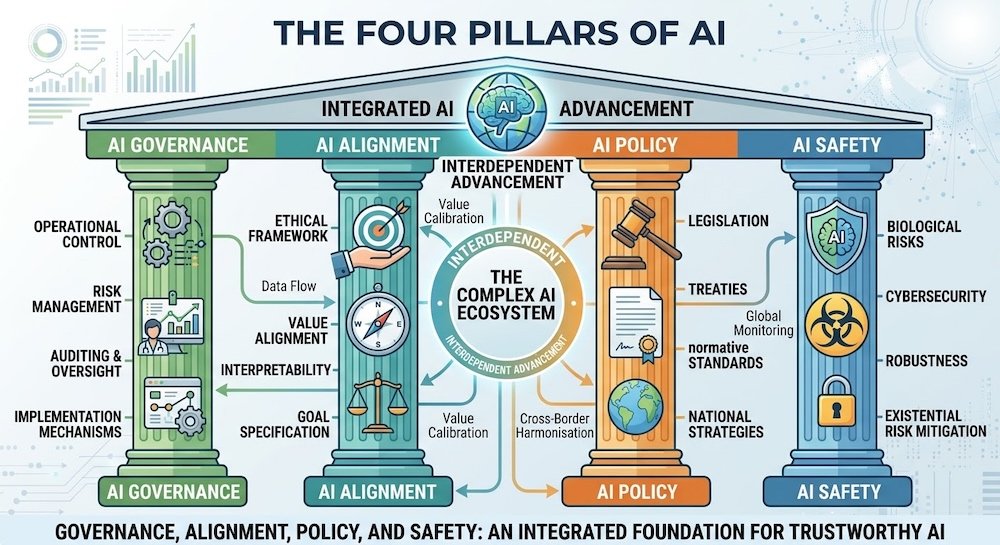
The Four Fundamental Pillars of AI

Image: Mark Lovett / AI GAPS — Generated with Gemini 3.8 Flash

Erik Leklem Explains: AI Governance Can’t Wait for a Treaty

In a previous article we asked, Is Global AI Governance Possible? and cited the International Atomic Energy Agency (IAEA) along with the Organisation for the Prohibition of Chemical Weapons (OPCW) as examples of the world coming together and forging responsible policies that all parties could support.

Industry experts have recently been calling for something similar in regard to the oversight of artificial intelligence. We don’t seem to have the political will at the moment to pull it off, but Erik Leklem offers us some insight as to how such a system might work.

Erik explains that his research focuses on three objectives that can get us ready for the day when crafting a treaty is possible.

  1. Survey existing international agreements and international treaties
  2. Design an organization that would implement an international AI treaty
  3. Prototype such an organization, especially around compute verification

In the near future, humanity may decide that we want an international AI agreement to regulate frontier AI development, and we may want an organization to implement that treaty. I’m worried that we won’t be ready in time, and I’m creating options through this research to help solve that problem.

The sense I get from most people in the industry is that such a treaty is out of reach due to the frayed relationship between the United States and Chinese governments and the lack of leadership in Washington, D.C. But I do support Erik’s belief that we should do the groundwork ahead of time: research, data gathering, and relationship building.

He reminds us that countries have made landmark agreements despite their political differences, and points to the Chemical Weapons Convention, which was negotiated between the United States and the Soviet Union at a time of intense rivalry. While initially opposing the idea, the chemical industry came around to see the benefit of transparent governance.

OPCW by the Numbers

193 States committed to the Chemical Weapons Convention • 98% of the global population live under the protection of the Convention • 100% of the chemical weapons stockpiles declared by possessor States have been verifiably destroyed. ~OPCW

While chemical precursors and weapons and artificial intelligence represent dissimilar industries, with very different risk factors, the Organization for the Prohibition of Chemical Weapons (OPCW) stands out as an example of what disparate groups can be accomplished with global cooperation.

Tracking AI Chips

But from there, Erik takes an interesting approach to what should be governed by such a treaty / organization – the chips used to create and serve IA systems.

We really don’t have a good global understanding of where that chip registry is. No one really has an official documented record of where all the chips are in the world and what they’re doing.

That seems like a daunting task – creating a database of all the AI chips around the world. How willing will countries, not to mention individual data centers, be to provide this data? And what other sources of information could contribute to such a project? I did some research and came up with a table that highlights some areas to look into.

Data source

What it can reveal

Reliability and limits

Company announcements and press releases

Cluster size, chip model, location, and timing for big projects

High for the announced facility, but companies often report GPU counts loosely or in different units

Satellite and aerial imagery

Construction progress and data center footprint, power and cooling build-outs

Good for locating sites and estimating scale, but cannot identify the chips inside

Energy and permit filings

Power capacity, grid connections, and local zoning approvals

Strong signal of scale, but power contracts don’t reveal chip types

TOP500 and similar supercomputer lists

Verified performance and configuration for public systems

Reliable but covers only systems that are submitted, mostly public or academic

Trade and customs data

Import volumes of GPUs and servers by country (using HS codes)

Useful for national totals, but classification is inconsistent and transshipment obscures origin

Earnings reports and supply-chain analysis

Aggregate shipment and revenue trends, packaging capacity such as TSMC CoWoS

Very reliable in aggregate, but not broken down by individual deployment

Export license and regulatory filings

Authorized exports of advanced chips to specific countries and buyers

Valuable where disclosed, but many licenses and enforcement actions are not public

Job postings, cloud pricing, and capacity announcements

Hints about where compute is being built or rented

Indirect and speculative on its own

As you can see, this is a complicated matrix of sources that would need to be monitored on a daily basis, with lots of uncertainty in the numbers.

Is the EU a Governance Prototype?

When is comes to AI governance, the most cited example, and one that Erik also mentions, is the EU; both the EU AI Office and the EU AI Act that came into effect in August of 2026. With chapters covering transparency, copyright, and safety & security, notable signatories include Amazon, Google, IBM, Microsoft, Mistral AI, OpenAI, and Anthropic. And the Act covers some 30 countries, so cross-border cooperation is a reality.

Looking Forward

In the end it may take a combination of the EU approach, the chemical weapons convention, and other entities, such as the Federal Aviation Administration (FAA) and the Federal Drug Administration (FDA) to help craft the structure of a global organization that can oversee the development and deployment of AI. What I’m certain of is that Erik Leklem is far from done on this topic, so I’ll be keeping tabs on his efforts to lay the groundwork for an eventual AI treaty. It can’t come soon enough.

Sam Altman Addresses the UN Security Council on the Need for Caution

There have been many calls from AI CEOs to approach the development of new frontier AI models in a safe and sane manner, but the speech that Sam Altman, CEO of OpenAI, gave to the United Nations Security Council is one that I have encouraged people to listen to. Not because it contains any specific solutions, but because it recognizes the stark reality that despite AI’s potential upside, it contains an equally powerful potential downside.

AI can either be more like a new renaissance of creativity and discovery, or more like a new industrial revolution of upheaval and disarray.

Since word choice is extremely important, listen to Sam’s address and make a note of the points he’s making regarding the need to recognize that negative consequences may arise and the desire for us to proceed down this path embracing extreme care.

As the process of building AI becomes more automated, the pace of AI progress could accelerate rapidly. This moment calls for extreme care.

While I agree with the statement below, as I see it, that’s not how the frontier AI companies are proceeding at the moment. Granted, there has been some effort, with a couple brief pauses undertaken in 2026, but we still don’t know enough about what AI systems are doing behind the scenes, and we have no standards for safe deployment.

We think it’s important that everyone avoids building systems where we cannot make the alignment, monitorability, and safety guarantees that we must. We need to understand what these systems are doing and have strong evidence that they will do what people intend, even as they get very, very smart actually, especially as they get very, very smart.

The key phrase here is “we need a mechanism”, as the desire for AI standards that measure capability, access risk, and determine whether safeguards are sufficient requires a formal process to be put in place.

In our history, there have been times where countries who compete and don’t always like each other very much still come together for shared interests and the collective good in the face of a powerful new technology. We believe this must be one of those times. We need a mechanism for complementary national and international frontier AI standards. Standards for measuring capabilities. Assessing risks, determining whether safeguards are sufficient, and preserving meaningful human oversight.

I’ve asked the question before: Is Global AI Governance Possible? and discussed the UN’s evolving governance role, but Sam leaves the question open as to how we should proceed. Which I feel means it’s time for an independent organization to take the lead on the topics of AI Governance, Alignment, Policy, and Safety.