

Open Letters, Declarations, and Pledges Demanding Safe AI Deployment
Over the years, several open letters, declarations, or pledges have called for the creation of AI systems that are safe to deploy and serve the needs of humanity, called for a pause in development of advanced AI, or proposed a complete ban on extremely advanced AI, such as artificial superintelligence (ASI). Each one is unique, yet all support the common theme of ensuring AI won’t cause harm.
Pacing the Frontier – July 28, 2026
Building on work already underway to monitor frontier model releases: We request that the U.S. government support an international effort to develop the technical and governance tools needed to deliberately pace the frontier of automated AI development. (excerpt)
The Pro-Human AI Declaration – March 24, 2026
AI systems must not be designed so that they can self-replicate, autonomously self-improve, resist shutdown, or control weapons of mass destruction. (excerpt)
- Keeping Humans in Charge
- Avoiding Concentration of Power
- Protecting the Human Experience
- Human Agency and Liberty
- Responsibility and Accountability for AI Companies
Statement on Superintelligence – September 22, 2025
Statement: We call for a prohibition on the development of superintelligence, not lifted before there is broad scientific consensus that it will be done safely and controllably, and strong public buy-in.
Global Call for AI Redlines – September 22, 2025
Governments must act decisively before the window for meaningful intervention closes. An international agreement on clear and verifiable red lines is necessary for preventing universally unacceptable risks. These red lines should build upon and enforce existing global frameworks and voluntary corporate commitments, ensuring that all advanced AI providers are accountable to shared thresholds. (excerpt) (Video: The Global Call for AI Red Lines)
Statement on AI Extinction Risk – May 30, 2023
The Statement: Mitigating the risk of extinction from AI should be a global priority alongside other societal-scale risks such as pandemics and nuclear war.
Pause Giant AI Experiments – March 22, 2023
Therefore, we call on all AI labs to immediately pause for at least 6 months the training of AI systems more powerful than GPT-4. This pause should be public and verifiable, and include all key actors. If such a pause cannot be enacted quickly, governments should step in and institute a moratorium. (excerpt) (Paper: Policymaking In The Pause)
Lethal Autonomous Weapons Pledge – June 6, 2018
Statement: Artificial intelligence (AI) is poised to play an increasing role in military systems. There is an urgent opportunity and necessity for citizens, policymakers, and leaders to distinguish between acceptable and unacceptable uses of AI. In this light, we the undersigned agree that the decision to take a human life should never be delegated to a machine.
Asilomar AI Principles – August 11, 2017
The goal of AI research should be to create not undirected intelligence, but beneficial intelligence. AI systems should be safe and secure throughout their operational lifetime, and verifiably so where applicable and feasible. (excerpts)
Despite the repeated calls for the release of responsible AI, and the tireless work being performed in the disciplines of governance, alignment, policy, and safety, frontier model developers and governments around the world continue to drag their feet when it comes to taking meaningful action.
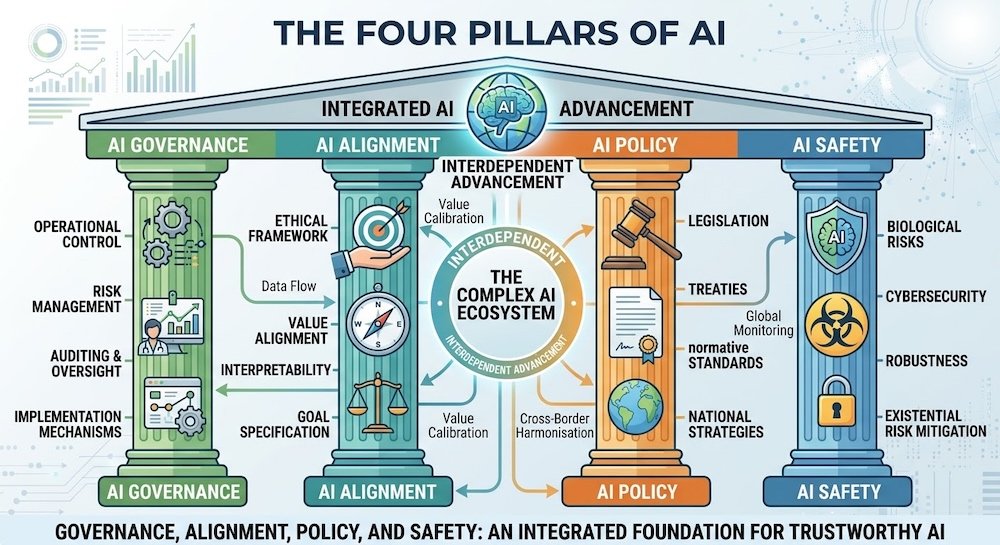
Image: Mark Lovett / AI GAPS — Generated with Gemini 3.8 Flash